

Roberto Giolito, the Heritage Keeper
- Marco Visani
- Apr 29
- 8 min read
A different background to all other car designers, an unusual artistic sensitivity and a unique professional career, that saw him develop from the drawing board to Head of Heritage for the Italian Stellantis brands. Who is Roberto Giolito, the man behind the Mirafiori Heritage Hub? And what is his vision of the history and style told through a divergent intelligence and a generally unusual approach to cars.
Words Marco Visani
Photography Leonardo Perugini
Video Andrea Ruggeri
Archive photo courtesy of the Roberto Giolito Archive

Roberto Giolito is not the best car designer, for one simple reason: the best people always move within a comparative environment.
[click to watch the video]
If you are number one, you are not so far from number two or three. Giolito, who was (a verb in the past tense: the first difference, but not the most important) an excellent designer, was on the other hand unique. Incomparable, unclassifiable, undefinable. Defining him merely as the man who designed the Fiat 500 - 312 (the 2007 model) and, just before that, the 1998 Multipla, is an understatement.

But also introducing him merely for what he does today, as Head of Stellantis Heritage, to use the inevitably sterile language of the corporate nomenclature, does not suffice for describing this multi-faceted character and his wide skills base.

He has spent his entire professional career going against the grain, yet without that determination to deliberately do things differently, as that would have made him nauseating. It’s just that being influenced by different stimuli, and consequently creating a style that goes beyond the simple – yet fundamental – shape of the car, has always come naturally to him. And this also gives his way of being a different meaning today, now that he is the custodian of the history of a great industrial group.

It is first and foremost his background that makes him stand out from the crowd. He is not from Turin (or rather, he is only in origins), nor is he from Milan or Modena — the three car capitals are therefore far from his studies — but from Ancona in the Marches region.

He did not attend the Polytechnic, he is not an engineer or an architect, but a pure designer, who cut his teeth at the ISIA in Rome. ISIA stands for the “Istituto Superiore per le Industrie Artistiche” – Higher Institute of Artistic Industries: from the name we can understand that his studies were far from rigid, and very open. Basically, he got his passion for cars from his father. Who designed cars… Was he a stylist? No, a trader: he sketched cars as a hobby. Seeing these, the young Roberto learned and developed one thing in particular, perhaps the most important you can learn in life: curiosity. That drive that makes you want to know and understand. And he broke down barriers, because knowledge and creativity know no boundaries. This is also where his passion for music came — jazz and the double bass in particular — which, like mathematics, has strict rules and infinite potential.

Furnishings and graphics became his daily bread for a few years. Then, in 1989, things changed: he applied for a job as a designer at Fiat, and during the interview he found himself talking to Ermanno Cressoni, the man behind many successful Alfa Romeos (from the Giulietta – 116 to 75, as well as the 33) who had recently come to Turin after the Arese-based company joined the Fiat group.

In almost thirty years as a designer, he blended the ability to innovate from scratch (the Multipla) with that of recovering past experiences and launching fresh ideas into the future (the 500, the 124 Spider). So, after such a brilliant career, it was almost inevitable that, in 2016, Sergio Marchionne thought of him to head the Heritage department of what was still called FCA, as Stellantis was born from the merger of FCA and the French PSA only in 2021.

And here we have to take a step back to get a closer look. For a company with 125 years of history — if we consider Fiat as the parent company of this group —, talking about heritage could seem a platitude. But not if that group is Fiat. Before Giolito took over the heritage department, the testimonials of its past were found only in the historical quarters in Via Chiabrera, Turin. It was an interesting collection, that spoke of the Fiat “Cielo Mare Terra” (“Sky, Sea and Land”), according to the 1930s slogan used when Fiat also made aircraft and marine engines, but in car terms had not moved since the 1960s. It was open to visitors only one Sunday a month, or every Sunday for a relatively short period: from the celebrations of the 150 years of Italian Unification (2011) to the pandemic (2020). The remainder of the memories could be found in an anonymous shed in Beinasco, on the western outskirts of the city. Fiat had stored dozens of vehicles there: they took one car from the assembly line as they left the production department, along with the few prototypes that luckily had not been demolished (the vast majority had unfortunately been crushed). There were Fiats and Lancias, the oldest ones put on show in the small museum in Borgo San Paolo, beneath the old headquarters when Lancia was still a separate entity to Fiat.






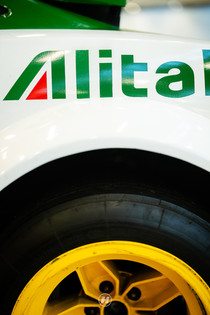
And while in Via Chiabrera the museum was for connoisseurs, Beinasco was a matter for proselytes. You got in if you were in with the right crowd or if, as in our case, you were given (privileged) access as a journalist. It was neither museum nor repository, just a warehouse: a temporary solution to prevent the cars from rotting while final arrangements were being made. The trait d’union between that warehouse and what today we know as the Heritage Hub is Roberto Giolito. It is thanks to him that the Fiat Auto collections are now on show to the public in a highly symbolic space. And this is where the SpeedHolics team met him.

The appointment was in Via Plava 80, Turin. The western end of Mirafiori Sud. The cardinal point is very important in the location of this place: built in 1939 to support and, in the medium term, take over from the city site at the Lingotto, the Fiat Mirafiori factory was already too small in 1956. This is why it was doubled in size, going beyond Corso Settembrini: the newly built area thus became Mirafiori Sud. In the golden years, over 60,000 people worked in this area, which ran for five kilometres along one side: the population of an average-sized provincial town. When the economic boom was over, tackling the fierce competition and lowering goals and ambitions, just a few thousand workers could be found at Mirafiori.

One of the many spaces left empty by the decentralised production (firstly central and southern Italy, then South America, Poland and the Balkans) was identified as the right place to set up something of a size and accessibility that Fiat had never had before. The premises are those of the former Officina 81, where instead of the previous transmissions, gears were made for the gearboxes of all the cars in production. Anyone who between the 1950s and the 1990s drove a Fiat will have had something to do with this building, even if they were not aware of this: a subtle and highly evocative choice. 230 cars can be found here, in an area covering 15,000 square metres, the size of a large hypermarket, and recently 79 were added from the ASI Bertone collection.
Another small trip back in time: when the Bertone bodywork firm folded in 2014, the company museum risked being sold off in pieces. ASI made an offer to ensure it remained intact and prevent it from being sold abroad, so that the heritage of Italian style could stay in its own country. The Bertone cars spent a few years in Volandia, the aviation museum at Milan’s Malpensa Airport: a very attractive location but far from coherent with these artifacts. And in recent weeks an agreement between ASI and the Heritage Hub has brought the Bertone cars permanently to Via Plava. Only a few of these are based on Fiat mechanical sub-assemblies, and their bonnets sport a wide range of names, from BMW to Volvo, from Jaguar to Lamborghini. You would have to visit the Henry Ford Museum in Detroit to find something even vaguely similar. In Europe, as far as we know there is nothing like it: this is the sign of a great cultural maturity, very close to Giolito's own ideas. And today, although a manager of history, he remains “sacerdos in aeternum” in his vocation as a designer. Of course, he would get involved in the idea of conserving a fleet of concept cars and (to a lesser extent) mass produced models of historical and documentary value.

What is great about the Heritage Hub is not only that enthusiasts can lose all concept of time and space, magnetised by the number of materials on show: it is also that they can discover the soul of brands that were once under the Fiat Group that were very distant from the idea — or the cliché — of a vehicle manufacturer for the mass market. Fiat was very often a byword for innovation: here, in the 1960s, came the antiskid system, the forerunner of the ABS, which was later industrialised in the USA for regulatory reasons; and it was Fiat that invented the common rail, in turn sold to Bosch. Ahead of its time, when electric mobility was nothing more than an exotic distraction, Fiat was working on this with the 1972 X1/23, the 1993 Downtown and the 1994 Zic, the last two the work of Giolito, who had not yet obtained the media success that he would soon earn with the brilliant (and rather controversial) Multipla. But what is showcased to the full at the Hub is that great Fiat, the star of motorsports.

Both not so long ago (the three world rallies won by the 131 Abarth and the five by the Lancia Delta HF Integrale, between 1977 and 1992, and the Stratos and Rally 037 in the meantime and, even before that, the Fulvia) and in remote times, when Fiat had not yet chosen to work in the general field and addressed even high-spending audiences, using its record cars for promotional purposes.
Two of these can be found in Via Plava, authentic technological masterpieces applied to racing, with the size — seen with today’s eyes — of trucks and an objectively worrying potential for vehicles with mechanical brakes only on the rear wheels: the 1908 S61 (a 10.1-litre four-cylinders with 115 HP and 150 km/h) and the 1924 Mefistofele (6 cylinders, 21.7 litres, 320 HP and 235 km/h). Two clues indicating the industrial scope of the brand and the ambitions of its founders.


The narration offered to visitors to the Heritage Hub is a far more complex and articulated world that we might imagine. There is a lot of technology, but also a lot of beauty: that thing that — as Giolito explains with a pleasing image — we note even before we are able to explain it. Beauty that is also the ethical meaning of certain projects that he worked on before the new millennium. Like the Ecobasic, the study for an essential and sustainable car (“we reuse or remove anything that is not needed”) when sustainability was still not a manufacturers’ priority.

And then there are services for collectors, called by a deliberately Italian name “Officine Classiche”: more than just a commercial operation to sell restoration services, but an exchange of expertise between people who share the same idea for one reason or another and a sense of belonging. And who with their stories build a great community. From past productions to today’s narrative, Officina 81 plays the role assigned to it by Giolito: the responsibility for making car history readable, lovable and above all tangible.

About the author, Marco Visani.
Born in Imola in 1967, he has been a journalist since 1986. After beginning his career as a reporter for Il Resto del Carlino and other local newspapers, he has been writing about automobiles since 1992. He has worked with magazines such as Quattroruote, Ruoteclassiche, TopGear, Youngtimer, Auto Italiana, Auto, AM, Sprint, InterAutoNews, and EpocAuto; with TG2 television; the portal Veloce.it; and with the English publisher Redwood Publishing, active in the field of customer magazines. He is currently the Italian correspondent for the French classic-car magazine Gazoline, editor-in-chief of the bimonthly ZeroA, and contributor to L’automobileclassica, Youngclassic, Quadrifoglio, and Tutto Porsche. He also manages heritage communication for Volvo Car Italia. His writings have appeared in Corriere dello Sport-Stadio, Avvenire, Tecnologie Meccaniche, Rétroviseur (France), and Top Auto (Spain). He has published and co-authored several books for Giorgio Nada Editore and other publishers from 2016.