If it is indeed a version of the Porsche 911 unanimously recognized for its qualities,
it's the Carrera RS 2.7. This little beast and its famous "duck tail" represents
THE sports car par excellence, capable of providing rare driving pleasure.
The 911 Carrera RS 2.7L is a driving legend.
Ten years after its first appearance, the famous name "Carrera" once again constitutes an element of the Porsche program and makes its entry into the 911 nomenclature. This name comes from one of the most famous races in the world which took place in Mexico in the 1950s and in which Porsche won several victories with the 356 and the 550 Spyder: the Carrera Panamericana. Presented in October 1972 at the Paris Motor Show, the 911 Carrera RS (for Renn Sport) was entirely designed for competition. When the International Sports Commission changed the regulations for motorsport in 1972, Porsche then coveted the European GT championship but found itself obliged to design and approve a model that was fundamentally sportier than the 911 2.4L S. As stipulated in the new regulation, the car must be produced in at least 500 examples to obtain approval in group 4. In terms of specifications, Porsche does not have many alternatives to reconcile budget and minimum deadlines. The Carrera RS was therefore mainly to be a lighter and more powerful variation of an existing model.
This successful launch was reinforced by the victory of the Carrera 2.8 RSR at the 24 Hours of Daytona in 1973. Motorsport enthusiasts discovered that not only was the car designed for competition but that it allowed daily use in town and on the road. At a time when speed was not limited, it made it possible to "drop off" all "sports cars" whether on the motorway or on a winding road.
Externally, the most striking feature of the RS is its famous spoiler nicknamed "duck tail". Integrated into the engine hood, it increases the downforce on the rear axle of the 911, reducing lift by 75%. But this delicious "seventies" look would not be so typical and charming without the two-tone marriage of the bright colors of the bodywork and the Fuchs rims linked by a Carrera logo all over the side. To mark the beast, Porsche adds a rear “Carrera RS” logo on the spoiler and “Porsche” lettering in the same color on the bottom of the engine cover. The 911 Carrera RS retains the body of the 2.4 S with the exception of the rear fenders which are specific because they are wider to accommodate the 7 rims. In front, the RS inaugurates, a polyester shield which integrates an additional oil radiator in place of the license plate on the well-known models under the name "Lightweight" (option M471). When a Porsche owner talks to you about a "light" or a "sport", it is about the 204 examples which have been lightened as much as possible. In detail, the weight loss envisaged by the factory was obtained by reducing the thickness of the sheets and glazing for certain elements, by the use of a specific auxiliary cover frame in forged aluminum, a plastic tank and bumpers, removal of various trims and soundproofing, engine hood lock, rear seats, dashboard upholstery, clock, storage compartments, armrests, handles door reminder. In addition, the front seats give way to two superb Recaro buckets.
These 204 models were all sold out. Alongside the "Sport", a "Touring" version (M472) was also available in the catalog. Indeed, Porsche had considered a less Spartan version from the start, underestimating the commercial potential of the Carrera RS Light. Featuring interior equipment very similar to that then available on the 2.4 S, the "Touring" or "comfort" abandons the lightweight windows and the aluminum and polyester bodywork elements, replaced by sheet metal. Given the success encountered during the first year (1972), two series of 536 then 554 examples were added in 1973 to the production initially planned, but with some slight differences compared to the approval model. The total production of the Porsche 911 Carrera RS will ultimately exceed 1,500 examples, also allowing its approval in Group 3.
The type 911/83 engine of the Porsche 911 Carrera RS is derived from that of the 2.4 S of 190 hp, pushed to 2687 cm3 by increasing the bore by 6 mm. The lessons learned from the competition will also allow Porsche to lighten the magnesium engine block by replacing the "Biral" cylinder liners with a treatment with "Nikasil", a very resistant alloy of nickel and silicon applied by electrolysis to the walls. cylinders. We also note the installation of lightweight flat-head pistons and a specific crankshaft. The compression ratio remains at 8.5:1 but the power of the new engine increases
Our 911 Carrera RS 2.7L M472
Carrera RS 1973 Chassis No 911 360 0519
Clear history (3 owners)
Chassis zinc plated by “shoopage” in 1987
Maintenance (1984/2002) and engine preparation by Louis Meznarie
2.8 RS engine designed and built by Louis Meznarie (89,000 km)
Louis Meznarie
Alias ´Ptit Louis' was born on January 14, 1930 in Saintry-sur-Seine, where he started as a motorcycle preparer, before becoming one of the greatest specialists in the preparation of racing cars and particularly Porsches, aligning his own Porsche at the 24 Hours of Le Mans with… a nickname: 'the wizard'!
Born to a father and a mother from the former Yugoslavia, he was attracted to mechanical games very early on, tinkering with all kinds of machines in his early days. At 13, he entered a repair shop and quickly acquired a bicycle with an auxiliary motor.
From 1945 until 1948, he worked in a motorcycle factory, MR (Mandille & Roux) rue des Prairies in Paris, which used 2-stroke Sachs engines. Then some Ydral!
At the beginning of the 1950s, he launched into Motocross with a single-cylinder NSU Max 250 cm3 OSL, where he met 'Jojo' Houel, Georges Monneret and Rémy Julienne, the future 'Monsieur Cascade' in France and Georges Diani, the future Garde of General De Gaulle's Corps, riding a Monet-Goyon equipped with a Villiers engine. Louis is preparing his first ‘Mobs’ and Motorcycles. From 1959 to 1971, he then became a car dealer for the German brand NSU.
In 1968, he opened a much larger workshop in Plessis-Chenet, near Corbeil in the commune of Coudray-Montceaux on the edge of the RN 7, with the support of the Shell oil company and he quickly became one of the preparers renowned brand of Porsche.
From 1971 to 1983, he was an official preparer of Porsche 911s, with a series of victories in their category at the 24 Hours of Le Mans, the French Rally Championship and the European Rally Championship.
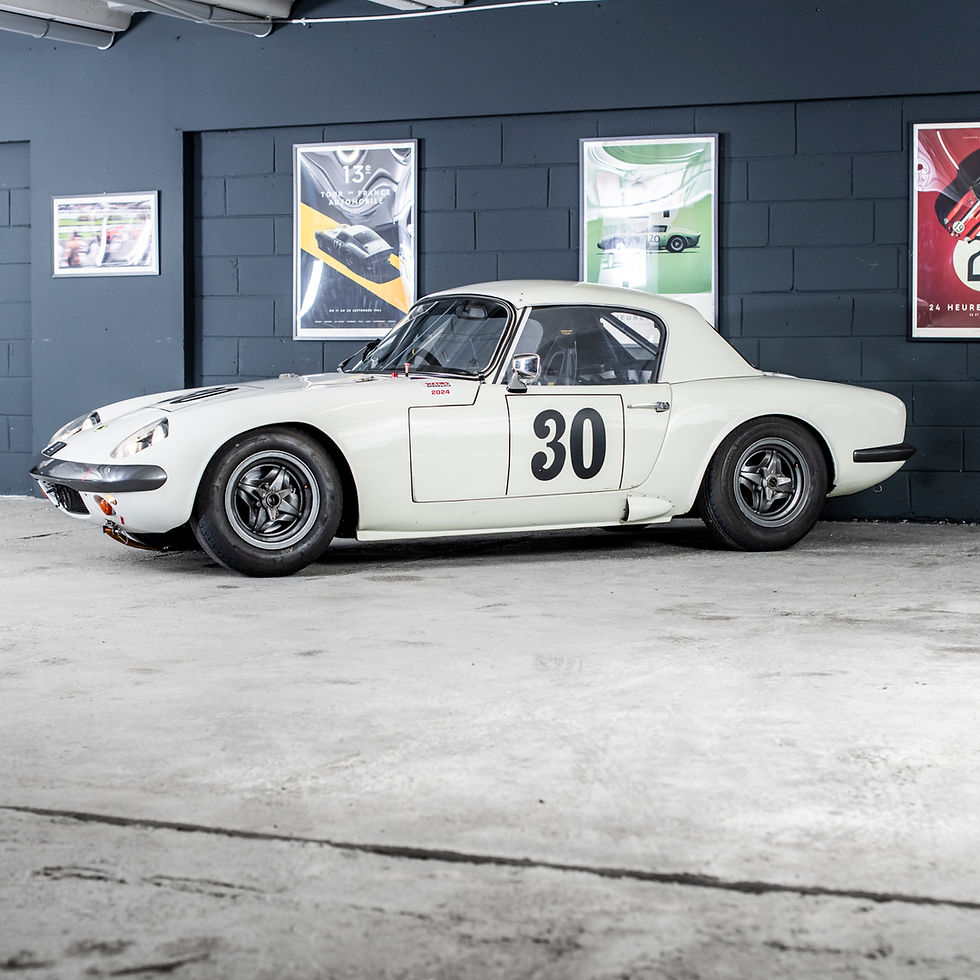
AN EXCEPTIONAL, UNIQUE, AUTHENTIC CARRERA RS 2.7
Historical
- March 22, 1973, off the line in M472 definition, called “Touring”, in French version (with a 2.4 S type front spoiler), one of the 161 RS in “Ivory White”, (paint code 1111), with the following catalog options:
“Recaro Sport” seats (option No 409)
Self-locking differential (option No 220)
- Reconfigured between 1975 and 1976, as a CARRERA 2.7 type G, to be “fashionable”, by its first owner! Joint operation at the time.
At this time, electric window lifts were also added (catalogue option No 651 for the 2.7 RS) which were not among the original options.
- Purchased by Mr. Déboucher from its first owner, towards the end of the seventies.
October 31, 1982, removal of the windshield and rear window to change the roof (black perforated imitation) and seat fabrics.
- November 5, 1982, complete painting and installation of a rear spoiler, by “Carrosserie Ducarme” in St Étienne.
- July 27, 1984, engine renovation at 88,300 km, at “Forez Racing Services”, a Porsche specialist known in Montbrison, including: rectification of the top of the liners, change of the injection pump and the intake throttle pump, replacement of connecting rod and line bearings, intermediate shaft, segments, valve guides and chain tensioners, engine seals, heat exchangers and clutch.
Installation of a shortened gear lever with reduced travel with reverse gear lock.
On this occasion it seems that the counter was reset to 0.
- December 6, 1984 purchase by the current owner, thanks to a small ad published in the “Centrale des Particuliers”, 105,000 km announced in the small ad and included on the invoice.
- December 21, 1984 inspection and minor maintenance at Sonauto, Levallois. 3,330 km on the clock.
- May 15, 1985 first maintenance invoice in a very long series, from the Meznarie garage. 11,300 km on the odometer according to the invoice.
- June 1, 1986 start of the restoration of the bodywork and the return to RS 1973 configuration, an operation which will extend until July 1987 and will include the following operations:
Complete dismantling of the vehicle and stripping bare.
Sandblasting of the body on April 15, 1987 at SPIC in Ceton,
Complete “Shoopage” of the body (hot zinc metallization) by STUDLER, specialist in surface protection of aeronautical structural parts, end of March 1987.
Change of front fenders, hood, front and rear masks.
Replacement or recovery of corroded parts in: the front bay, the floors, front and rear wheel arches, the windshield and rear window bays, passage to the marble,
change of the windshield and trim of the “Recaro” redone in leather and velvet, conforming to the origin, reinforcement of the front and rear suspension attachments, like the 2.8 RSR.
May 25, 1987, painting
As evidenced by the important file entrusted by its owner, we can retrace mile after mile the many stages of development of our RS. Its owner’s objective has always been to optimize the performance of his car in a “Grand Touring, Rally” approach. A very high-performance "road car" rather than a "pistar", evolving over time thanks to the interventions of Louis Meznarie in the 3 areas which are the foundations of the RS concept at Porsche, using only approved parts and modifications. Porsche:
Relief
Improved ground connections and braking;
Increased power and torque
The car we are presenting today is witness to 40 years of passion, developments and kilometers. A true love story between the owner and his car, carried out at high speed.
PREPARATION DETAILS
To achieve the desired goal it was necessary to use not only the “Options Catalogues”, the “factory upgrades” approved in Gr 3 and 4 by the FIA for the RS and RSR, but also the unique know-how, the competition experience , suggestions and advice from the “Sorcerer of Essonne”.
In the end, leading in stages to a 2.7 RS Louis Meznarie, therefore special and unique, but perfectly authentic, having benefited for its preparation from the technical developments of the brand, faithful in this to the research policy of “mechanical excellence » from Porsche, constantly integrating technical progress and knowledge from competition.
Improved ground connections and braking
Preparation began by replacing the 23 mm rear torsion bars with 26 mm models and increasing the front stabilizer bars from 15 to 18 mm, to increase directional stability and cornering speed.
These modifications were completed by the mounting at the front of RSR Bilsten Type V8 struts (FIA sheet 6/6 of February 12, 1973) of RSR whose spindle raised by 18 mm makes it possible to lower the ride height by 10 mm without reducing the travel of the suspensions and the H8 gas shock absorbers at the rear.
Rims of 7 and 8 *15 replaced those of 6 and 7 of origin (FIA Gr 3 sheet, No: 637 7/7v of December 12, 1973) to allow the use of tires of 205/55/15 at front and 225/50/15 at the rear, instead of the initial 185/70/15 and 205/55/15 and obtain better lateral acceleration.
To improve the rigidity of the trains and that of the body, a strut bar was installed between the front anchor points (FIA Sheet Gr4, No: 3053 1/1v of October 27, 1972), “Uniball” joints were substituted to the original silent blocks and metal reinforcements were welded, at the height of the front and rear axle strut mountings (FIA Gr4 Sheet, No 3053 15/4E of August 1, 1975) as on the 2.8 and 3l RSR.
Finally, Turbo type steering rods which provide better steering guidance replaced those of the 2.7 RS type.
Note that the replacement of the rear sheet metal suspension arms with aluminum arms, mentioned above, contributes to the improvement of road holding not only by reducing the weight of the suspended masses (6 kg) but also by increase, admittedly small, in the wheelbase.
Likewise the removal as part of the transition to the M. 471 configuration of one of the 2 batteries and its installation in the housing reserved for additional heating in the trunk, to allow passage into the front bins freed from the air ducts intended to cool the brakes and the front wing oil radiator (FIA Gr4 Sheet, No: 3053 5/5v of October 27, 1972); results in better mass centering when the driver is alone.
Increase in engine power and torque
In 1995, “Louis” was finally able to exercise his talents as an engine driver. The original engine had reached the end of its potential after 177,871 kilometers of good and loyal service. As the magnesium crankcase became porous and lost its rigidity, it was decided to replace the engine with a new 2.8L, single ignition, retaining the original injection, developed according to the specifications of the “wizard of Essonne”.
It was made from a latest generation magnesium crankcase (type 901.101.102.7R), purchased from “Auto Mechanika” in the USA, with a new crankshaft obtained from Porsche in standard exchange by Louis, new Malhe liners/pistons assemblies 2.8 RSR, “Dilivar” studs, a high flow oil pump (type 1976) and hydraulic tensioners,
The 2.7 cylinder heads, rectified at “Bozon”, were fitted with: new valves, guides, springs and rocker arms.
The flywheel replaced by a lightweight RSR type model, supplemented by a clutch disc and a lightweight, sports mechanism.
Finally a new bevel gear and a new intermediate shaft were fitted.