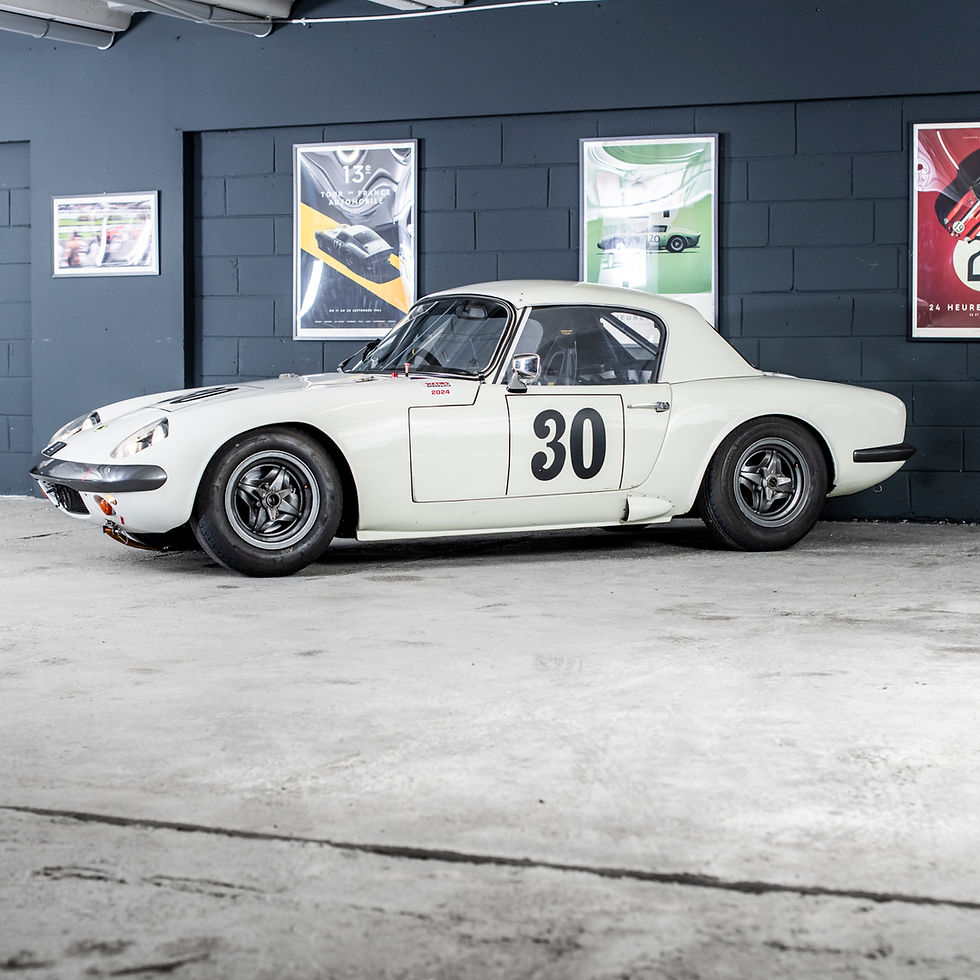
Lotus founder Colin Chapman assembled a team of volunteers to help him create a revolutionary model for 1956. While the production Lotus Marks 8, 9 and 10 were based on the Lotus Mark 6, the Eleven was designed from scratch. Its closest ancestor was the Mk 9 Le Mans factory racing car, registered XPE 6, a test bed for what was to follow. The Eleven used a steel tube chassis with aluminium panels. The elegant chassis weighed less than 30 kg. It was powered by the new Coventry-Climax four-cylinder aluminium engine, an overhead cam design with an impressive power-to-weight ratio. Girling disc brakes were used, and parts adapted from all kinds of English cars of the time made up the rest of the machine. The vehicle was covered with a stunning aerodynamic body designed by Frank Costin: handcrafted in aluminium and hinged at both ends for easy access.
Lotus cars were considered ‘scientifically designed’ racing cars, with each component studied to achieve maximum efficiency for minimum weight.
Chapman's philosophy was that each part should fulfil at least two functions, without weighing more than was absolutely necessary to do the job. Contemporary racing drivers considered the Lotus to be THE car to win races, even at the risk of not finishing at all.
From January 1956, when the first Elevens were hastily assembled for their presentation to the press in AutoSport or to be shipped to the United States for their racing debut, the cars were built as quickly as the small Lotus workshop could manage. The chassis were manufactured by Progress Chassis Co. and the bodywork and panels by Williams & Pritchard, both of which were practically neighbours. The cars were either assembled in-house or sold as kits. The Elevens could be ordered in the full Le Mans version, which used a de Dion rear suspension, or in the less expensive Club version, which used an Austin rear axle and drum brakes. Finally, a Sports version was available, which was essentially a Club with a Ford 10 engine. Initially, all Elevens used a swing axle front suspension modified from parts of the British Ford 93E model. In the spring of 1957, after about 150 cars had been produced, a new version of the Eleven was introduced as the Series 2. The main difference, which was generally only found on the Le Mans version, was the Lotus 12-type double A-arm front suspension, which gave the car a smoother and more consistent ride. The S-2 had chassis improvements, a stronger powertrain and could accommodate larger engines. By the summer of 1958, a total of around 270 Elemens had been built when production turned to newer models, including Formula 1 cars. The Eleven was the first Lotus to be built in such large numbers, and it firmly established the company as a serious manufacturer of competition cars. It held such a place in Chapman's heart that future Lotus cars were given names reminiscent of it, such as Elite and Elan.
Colin Chapman was in the habit of developing a prototype during the racing season for production the following year. The 1956 Mark XI followed this policy and had a new chassis that differed significantly from the previous year's production cars. It was available as an easy-to-assemble kit. Although the chassis frame was multi-tubular, the details were different, with the main lower tubes being one inch square instead of round. The others were 1.5 cm round tubes with a thickness varying between 18 and 20. There are fewer tubes, which reduces weight, but rigidity has been maintained thanks to a 20-gauge light alloy sheet metal floor tunnel.
The swing axle system has been retained at the front, but the pivot points have been lowered, which should further improve the Lotus' exceptional cornering capabilities. The pivot bearings are located in a rigid steel section. This arrangement facilitates the assembly of the entire front suspension system, and the Ford axle beams have been ‘adjusted’ to allow the roll centre to be lowered. A new Girling-type suspension unit with integrated shock absorbers has been used. Morris Minor rack and pinion steering with a three-piece column was chosen, and the wire wheels are 15-inch Dunlops with centre nuts.
Although a De Dion rear axle system has been retained, it is entirely new. The universal joints are located at the ends of the tube, which has a diameter of 3 inches, a quarter of an inch larger than the previous car. The De Dion tube is composed of three tubular arms, two of which are parallel at the front and rear, but the third forms a semicircle at the rear of the chassis.
The available gear ratios are 4.89, 4.55, 4.22, 3.89 and 3.66 to 1. The inboard brakes at the rear and external brakes at the front are all Girling type with 9-inch diameter discs and the latest caliper mechanism.
From an exterior perspective, the bodywork is once again very aerodynamic, but much lower than the S1. The aerodynamic purpose of the spoilers on the previous Lotus has been replaced by a central spoiler behind the driver's head, which is removable for mechanical work. The body is four inches wider and more rounded at the sides, making the cockpit spacious and easily accessible with light alloy doors on each side.
Although it was usually powered only by a 1,100 cc Climax engine, the Eleven, in expert hands, could beat most other racing cars.
The combined effect of good power, low weight, unrivalled aerodynamics, powerful brakes and exemplary handling was such that the Eleven had no rival in the 1,100 cc class and was almost as dominant in the 1,500 cc class. It was competitive in the up to 2-litre class, and on the right track, it could beat any sports car, regardless of engine size.
After an aborted competitive debut at Sebring in March, the Elevens competed in races in England. Colin Chapman and others drove the cars to a string of victories and track records. For years, there was talk of an epic duel at Goodwood between the Elevens driven by Chapman and Mike Hawthorn.
Around the world, the cars began to fill the grids of the 1,100cc sports car class (or G class), the predecessor of Formula Junior and an entry level for international competition.
At the 24 Hours of Le Mans, a team of three cars was entered: the car driven by Reg Bicknell and Peter Jopp finished seventh overall and first in its class.
That autumn, a specially faired Eleven, driven by Stirling Moss and ‘Mac’ Fraser, raced at Monza and set a series of world speed records on a closed circuit. The 1,100cc car covered 100 km at 135 mph, with a fast lap of 143 mph.
During the 1956 season, the Elevens won at least 148 races.
In 1957, with more than a hundred Elevens in action around the world, the domination continued. The highlights began with a class victory at Sebring by Chapman and Joe Sheppard.
The highlight of 1958 was the Elevens' overwhelming victory in their class at Sebring. There, the Weiss/Tallaksen car finished an incredible fourth overall with only 1,100 cc. Gradually, however, the rapid evolution of racing caught up with the Eleven, and while it was still competitive, Lotus prepared a successor. In 1959, the Lotus 17 appeared, lower and lighter, but even it could not match the Eleven's handling and overall speed. The true replacement finally appeared in 1962 with the brilliant Lotus 23 as part of the rear-engine revolution that ended the era the Eleven had dominated.
Around the world, dozens of Lotus Elevens found new life in amateur club racing and as ‘school’ cars. In the 1960s, many drivers got their first taste of racing behind the wheel of one of these old thoroughbreds.
With 270 units built between 1956 and 1958, the Lotus Eleven was a synthesis of all Colin Chapman's experience and expertise at the time of its release. Designed for endurance and sprint racing for small cars, this new Lotus, which introduced the E names, quickly attracted a clientele of demanding sportsmen and gentleman drivers.
Chassis 515 – 24 Hours of Le Mans 1958
In May 1958, Lotus Engineering completed the construction of chassis 515.
The Lotus XI was then at the peak of its technical maturity. Chassis 515 was delivered new to Bill Frost, owner of the Car Exchange dealership in Brighton. The car was registered as 2411 HP. Its configuration was clear: Le Mans Series 2 specification, with a high windscreen and ‘High Tail’ rear, magnesium wheels and a Coventry Climax FWA No. 7701 engine combined with a close-ratio MGA gearbox. Everything indicated that its destination was already known.
A few weeks later, the Lotus was entered in the 1958 24 Hours of Le Mans under number 39 by Car Exchange. The crew consisted of Bill Frost and Bob Hicks in the highly competitive 1100 cc class.
The 1958 edition was marked by particularly challenging weather conditions. In heavy rain, the little Lotus demonstrated the intelligence of its design. Light, precise and balanced, it led its category in the early hours of the race. But the Sarthe remains unpredictable. On the Mulsanne Straight, the car lost control in precarious grip conditions. Immobilised, it was then hit by an Alfa Romeo. After three hours of racing, retirement was inevitable.
The Historic Lotus Register archives formally confirm its identity: chassis 515, entered by Car Exchange, number 39, retired after three hours.
Like many endurance cars of that era, the 515 did not disappear after this episode. It probably returned to Brighton where it was rebuilt. There are indications that it may have raced at Goodwood shortly before Le Mans during the 1958 Whitsun Meeting, a hypothesis consistent with Bill Frost's activity in Sussex, although this remains to be definitively documented.
Over the years, the car left the United Kingdom and crossed the Atlantic. In the 1980s, it belonged to Harold Phillip Javetz in Savannah, Georgia. An amateur driver and passionate collector, Javetz kept the Lotus in its original configuration. In 1985, the car appeared in the American specialist press, notably in Thoroughbred & Classic Cars, where Innes Ireland was photographed alongside the XI – a highlight that helped to revive its Le Mans past.
In 1988, the Lotus was sold to Ed Henning, also in the United States.
In 1991, chassis 515 returned to the United Kingdom in the hands of Bill Harding. This marked a turning point: the Historic Lotus Register officially confirmed its chassis number, its original registration and its participation in the 1958 24 Hours of Le Mans under number 39.
In the same year, the car was acquired by Carol Spagg. Inspected and documented by Graham Capel, it returned to British and European historic circuits during the 1990s. Correspondence from 1998 attests to its FIA compliance in 1098 cc configuration.
In 2006, the XI 515 joined the collection of a French amateur driver. It took part in the 2008, 2014 and 2016 editions of Le Mans Classic, returning to the track where it had raced half a century earlier.
In March 2022, the car was acquired by its current owner.
Today, the 515 chassis retains the fundamental elements that define its identity: its Le Mans ‘High Tail’ configuration, its 1098 cc engine, its historical consistency and continuous traceability spanning more than six decades.
The 515 chassis is not just a Lotus XI.
It is a car that was ordered new for Le Mans, entered in one of the most difficult editions of the time, rebuilt, preserved, passed on from enthusiasts to collectors, and then returned to race on the circuit that shaped its legend.
It was recently entered by its current owner at Le Mans Classic, Goodwood and the Gentlemen Challenge at Peter Auto. Perfectly maintained with a newly rebuilt and bench-tested engine, compliant with its Weber DCO3 carburettors, it perfectly embodies the Lotus spirit of the late 1950s: technical intelligence, mechanical elegance and courage on the track.
________________________________________
Summary of owners
1958 – Bill Frost / Car Exchange (Brighton)
1960s – Probable competition activity
1984 – Harold Javetz (USA)
1988 – Ed Henning (USA)
1991 – Bill Harding (UK)
1991 – Carol Spagg (UK)
2006 – Eric Leroy (France)
2022 – Current Owner
It is eligible for the biggest motor racing events: Goodwood, Le Mans Classic, the Tour Auto, the Gentleman Challenge by Peter Auto, Motor Racing Legends and the GTSCC with Flavien and Vanessa Marçais... to name but a few!