

True Blue
Almost all the Shamal models built were red or black, despite being available in the full palette offered by Maserati in the early 1990s. We managed to get our hands on one of the very few examples finished — and, fortunately, still preserved — in blue. The story of an uncommon car to introduce an equally uncommon model: one that brought the V8 back into Maserati’s range and raised both the image and the ambitions of the sports cars derived from the prolific Biturbo family.
Words Marco Visani
Photography Leonardo Perugini

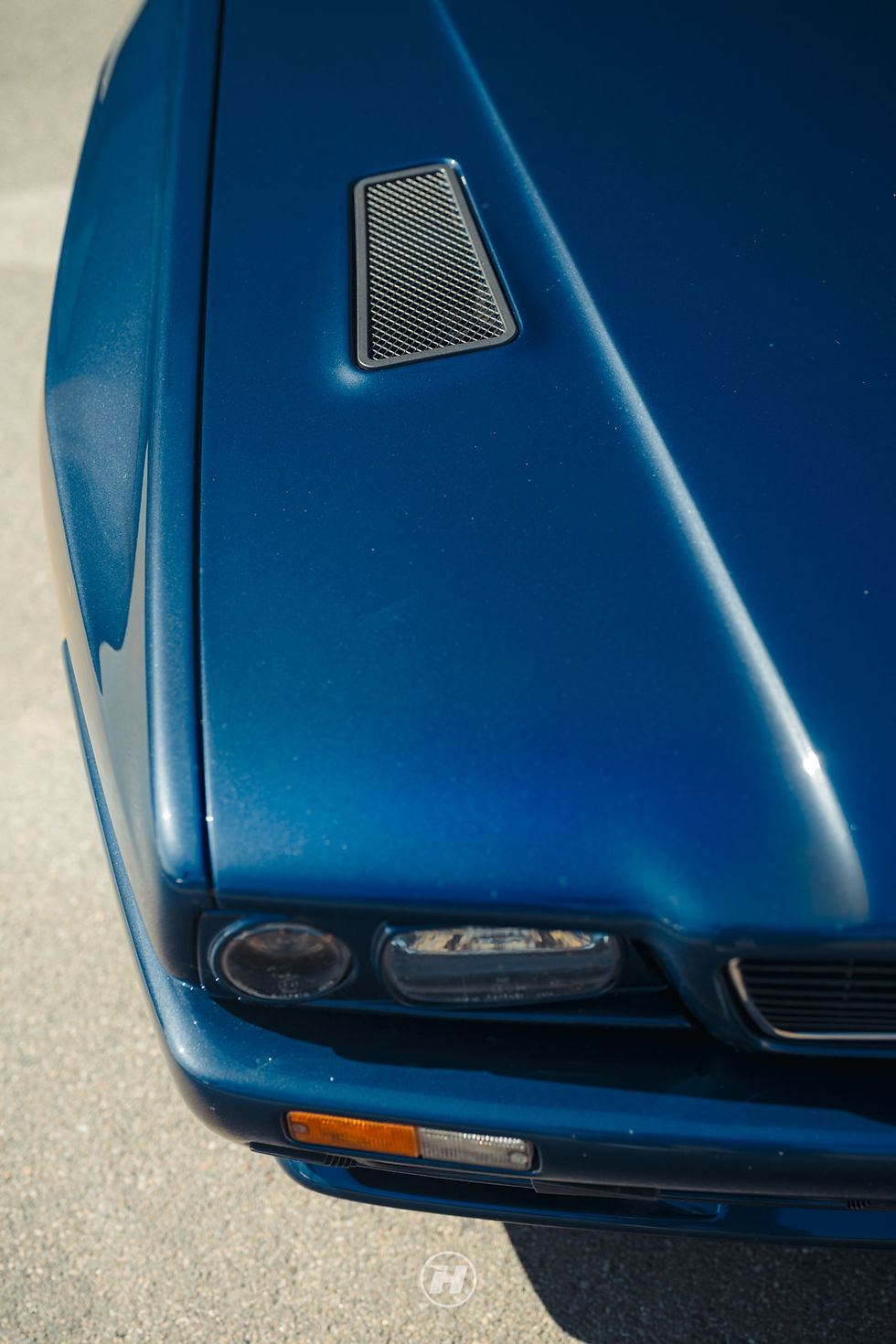
To tell the story of a car starting from its colour can mean one of two things: either the narrator is unusual, or the colour is. As for the former, we are far too involved to judge. As for the latter, there is no doubt: encountering a blue Maserati Shamal is rarer than finding a needle in a haystack. For the simple reason that almost all those that left the assembly lines on Viale Ciro Menotti, in Modena — save, it seems, for little more than a dozen — were Rosso Maserati or Dazing Black.
An unusual misunderstanding lay behind this near-unanimity: the brand’s official communication — press release images and brochure photography — portrayed the car exclusively in these two shades. Colours that were, in fact, a nod to the contemporary Biturbo Racing, itself offered only in those hues. Whether customers walked into a Maserati dealership already intent on ordering their car in red or black, or whether these colours were subtly “imposed” by salesmen despite the availability of the full Maserati palette — both solid and metallic — remains unclear. Claudio Ivaldi, president of the Biturbo Club Italia and author of Maserati: L’era Biturbo, a 416-page tome that stands as the definitive bible of this model family (if you do not already own it, you should — it is an extraordinary read), offers no firm hypothesis. Or rather, he advances a cautious, almost inverse suggestion: since the overwhelming majority of early cars were sold in red or black, subsequent buyers simply came to believe those were the only available options.

However it happened — and by now it matters little — the fact remains that our Shamal, the one featured in these pages, is finished in Blu Sera. Its owner, Fabio De Domenico, is a 73-year-old Sicilian gentleman driver with mineral oil running through his veins — drawn, needless to say, from the sump of a Maserati.

“The spark,” he tells us, “was struck at first sight. It was 1983 when I brought home my first Biturbo, still carburettor-fed and with the digital clock.” Soon after came the oval analogue unit, objectively far more elegant. Yet being able to say that your car still carried the liquid-crystal display — however modest and awkward — is precisely the sort of detail that makes a Trident aficionado smile knowingly.

By 1987, the lure of open-air driving prevailed: he sold the coupé and replaced it with a Biturbo Spyder, still in his garage today with fewer than 50,000 kilometres. There were others in between, but Fabio is not one to boast or dwell on numbers. Above all, he values quality over quantity. Proof of this came when choosing a Shamal: there was no hesitation. He acquired it in 2023 from its first owner, a gentleman from Messina, complete with its original registration plate — the final digits reminiscent of James Bond. A subtle suggestion, perhaps, that 007 might be missing out by insisting on driving Aston Martins.

Built on 22 October 1992 and registered on 17 November, the car was in excellent condition, though it betrayed the previous owner’s taste for light customisation: minor sins such as a Momo sports steering wheel, an aluminium gear knob in place of the original wood, and other small “interpretations”. All swiftly reversed within days — just long enough for the correct parts to arrive and for Fabio to restore them with meticulous care. We agree with him: history is best preserved with absolute respect, and if that earns you the label of obsessive, take it as a compliment.
With a car like this, satisfaction comes unbidden. At its first public appearance, the 2023 Maserati International Rally in Barcelona, it won the “Biturbos and derived” class and received its award from Adolfo Orsi — grandson of the man who chaired Maserati from 1937 to 1968. No small achievement.
The Shamal marked a return to values that had been lost in Maserati’s De Tomaso era. It emerged at a time when Fiat was beginning to acquire a stake in the company — full ownership would follow in 1993 — yet the project itself belongs entirely to the previous management. To begin with, after years of somewhat cryptic numerical designations, it revived the tradition of naming cars after winds, as the Karif had done before it. “A summer wind, from the northwest, originating in Mesopotamia,” explained the Shamal’s brochure, in a deliberately elevated tone that avoided mentioning Iraq at a time — as now — of delicate geopolitical tensions.

The car was developed on the shortest of the three Biturbo platforms: a 2.4-metre wheelbase shared with the Spyder and Karif. This both revealed the lack of funds for an entirely new model and showcased Maserati’s ability, as the French would say, to faire du nouveau avec du vieux. Doors and windscreen were carried over from other models — a significant constraint that did not deter designer Marcello Gandini. He created a coupé that was aggressive yet controlled, firmly planted thanks to a noticeably wider rear track, with his signature upward sweep of the rear wheel arch and a contrasting treatment of the thick B-pillar and roof, suggesting a removable hardtop and targa configuration. Pure illusion — but effective in lightening and animating the design.
The rest was achieved through a raised tail, a faired-in scuttle improving aerodynamics while masking the mature base design, and asymmetrical front lighting — a round projector lamp on the outside, a rectangular unit within — shared with the Racing, from which it also borrowed its wheels, albeit in larger dimensions. Spoilers and side skirts completed the look, in line with the stylistic conventions of the time.
Inside, aside from the seats, the cabin was largely identical to the Karif’s, including its 2+2 homologation — though the rear seats are best suited to very small passengers.
The true highlight, however, lay beneath the bonnet. After years dominated by a range of V6 engines — while the naturally aspirated V8 survived only in the Quattroporte III, produced in very limited numbers — the Shamal introduced a completely new V8, developed by Walter Ghidoni. Unrelated to the flagship’s engine, it was a modular evolution of the twin-turbo V6, with an additional cylinder per bank: 3,217 cc, 32 valves, four overhead camshafts and a catalytic converter, producing 322 horsepower (later increased to 326) — more than the “entry-level” Ferraris of the period.
Top speed approached 260 km/h (later 270), and 0–100 km/h took just 5.3 seconds. Other innovations included a six-speed Getrag gearbox and a tubular rear subframe, replacing the stamped structure to better handle power and torque — 44 kgm at 2,800 rpm, for the record. While the Ranger differential and electronically adjustable Koni dampers represented state-of-the-art technology, the brakes lagged behind: enlarged compared to lesser Biturbos, yet lacking ABS altogether. De Tomaso saw no need for it and refused even to consider it as an option.
In fairness, the early development of anti-lock systems in the 1990s was not without flaws — we once witnessed a Lotus crash into a low wall in a gravel car park when the sensors misinterpreted the surface and reduced braking force entirely. Not entirely irrational, then, his resistance. Still, with such technical credentials, the Shamal stood as the most high-performing Biturbo derivative ever produced — and the only one with a V8.

The Shamal was first revealed on 14 December 1989, at Maserati’s traditional anniversary celebration — a commendable custom introduced by De Tomaso that one hopes might one day return. The car was almost production-ready, aside from details such as the wheels — burnished on the prototype — and the bonnet vents, silver and louvred rather than black mesh. Yet production plans, by De Tomaso’s own admission, were still undefined.
Like a true star, the car toured motor shows throughout 1990 before returning to Modena on 14 December, accompanied by confirmation that production would proceed. During the Christmas period, Maserati issued its first price list featuring the Shamal. The first customer cars were delivered at the end of January 1991.
These were affluent buyers, willing to accept the higher VAT rate — 38 per cent rather than 19 — applied in Italy at the time to cars exceeding two litres in displacement. This tax threshold, incidentally, explains the success of smaller Biturbo models on the domestic market. The Shamal cost 125 million lire — twice the price of a 2.24v. It was certainly more exclusive, but for many buyers the increase in image and performance did not justify such an outlay.

Abroad, however, the picture was far more favourable — particularly in Japan, where 90 orders arrived from Tokyo as soon as books opened. De Tomaso, who had planned a limited production run of 450 units over three years, even considered removing the cap to meet demand. It was not to be. Corporate turbulence, the transition to Fiat Auto, internal competition — first from the Karif (until 1992), then especially from the Ghibli (from 1993) — and a dynamic character perhaps too demanding for a largely road-focused clientele all curtailed the ambitions of a model that had much to offer.
Production continued until March 1996 — more than two years longer than planned — yet total output reached only 369 units, of which 37 were right-hand drive.
What remains of the Shamal, beyond its memory, is its engine: that magnificent V8, later used in the Quattroporte IV and, above all, in the 3200 GT, which in 1998 would take up the mantle of Maserati’s great grand tourer.
About the author, Marco Visani.
Born in Imola in 1967, he has been a journalist since 1986. After beginning his career as a reporter for Il Resto del Carlino and other local newspapers, he has been writing about automobiles since 1992. He has worked with magazines such as Quattroruote, Ruoteclassiche, TopGear, Youngtimer, Auto Italiana, Auto, AM, Sprint, InterAutoNews, and EpocAuto; with TG2 television; the portal Veloce.it; and with the English publisher Redwood Publishing, active in the field of customer magazines. He is currently the Italian correspondent for the French classic-car magazine Gazoline, editor-in-chief of the bimonthly ZeroA, and contributor to L’automobileclassica, Youngclassic, Quadrifoglio, and Tutto Porsche. He also manages heritage communication for Volvo Car Italia. His writings have appeared in Corriere dello Sport-Stadio, Avvenire, Tecnologie Meccaniche, Rétroviseur (France), and Top Auto (Spain). He has published and co-authored several books for Giorgio Nada Editore and other publishers from 2016.


Comments