

A Boy’s Dream
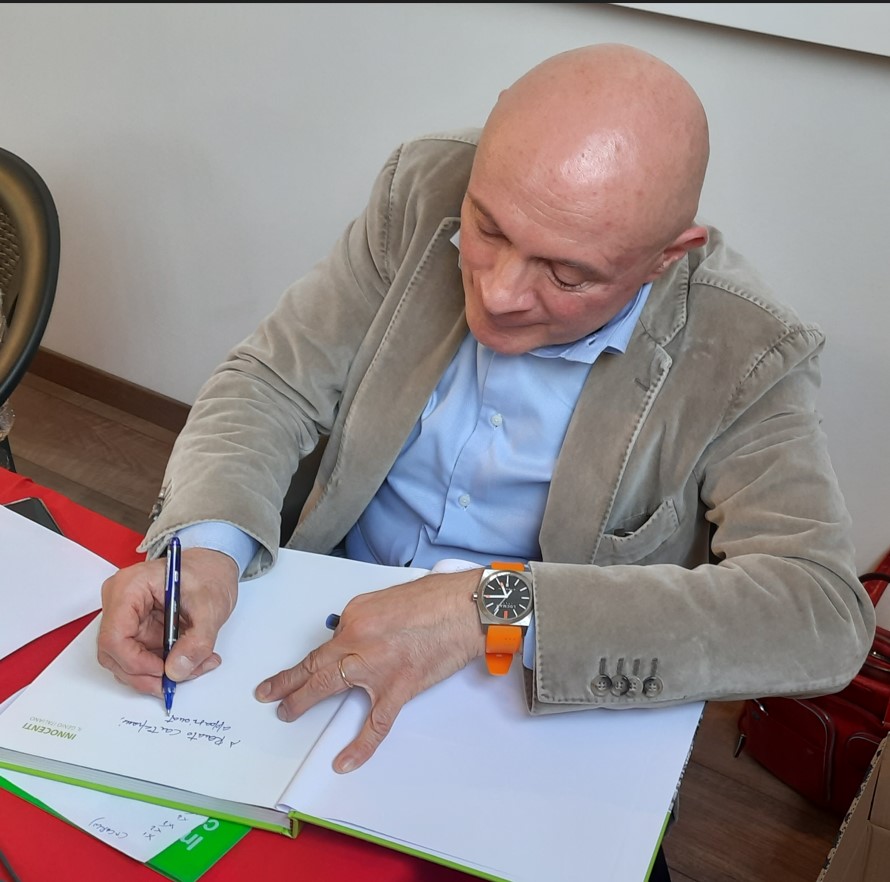
The most bourgeois and least-known variant of the prolific Biturbo family, told through the passion of a collector. A collector who, when he was a boy, worked at Maserati. And who, as he walked through the factory yards, dreamed of one day wrapping his hands around the steering wheel of a 228. A story in which passion and work intertwine, and where the protagonists who made the headlines walk side by side with the technicians who helped design, build, and bring these cars to the world.
Words: Marco Visani
Photography: Leonardo Perugini

Every time Marco left the company canteen to return to the office, he passed through the courtyard. And in the courtyard he would find the cars completed during the morning, neatly lined up. It wasn’t as though they formed kilometre-long rows. Just a few units, and if you paid close attention, you could almost recognise them one by one, perhaps even playing at giving them an imaginary name depending on the series, the customer’s chosen trim, and of course, the colour. In the end, it was a way to humanise them. As Marco did, fuelled by the thrill of having found himself working in a magical place for someone passionate about engines. Who knows how many technical-school graduates came out of his city’s schools each year. And inevitably only a few among them were lucky enough, instead of being hired by one of the countless companies in the supply chain—or even in sectors completely unrelated to automotive—to enter the true gotha of motoring: on one side (that is, Ferrari), or on the other side, meaning Maserati, using the expression coined by the Commendatore, which expressed all his detachment (to say the least) for anything in Modena that had four wheels, a very powerful engine, but a trident instead of a prancing horse.
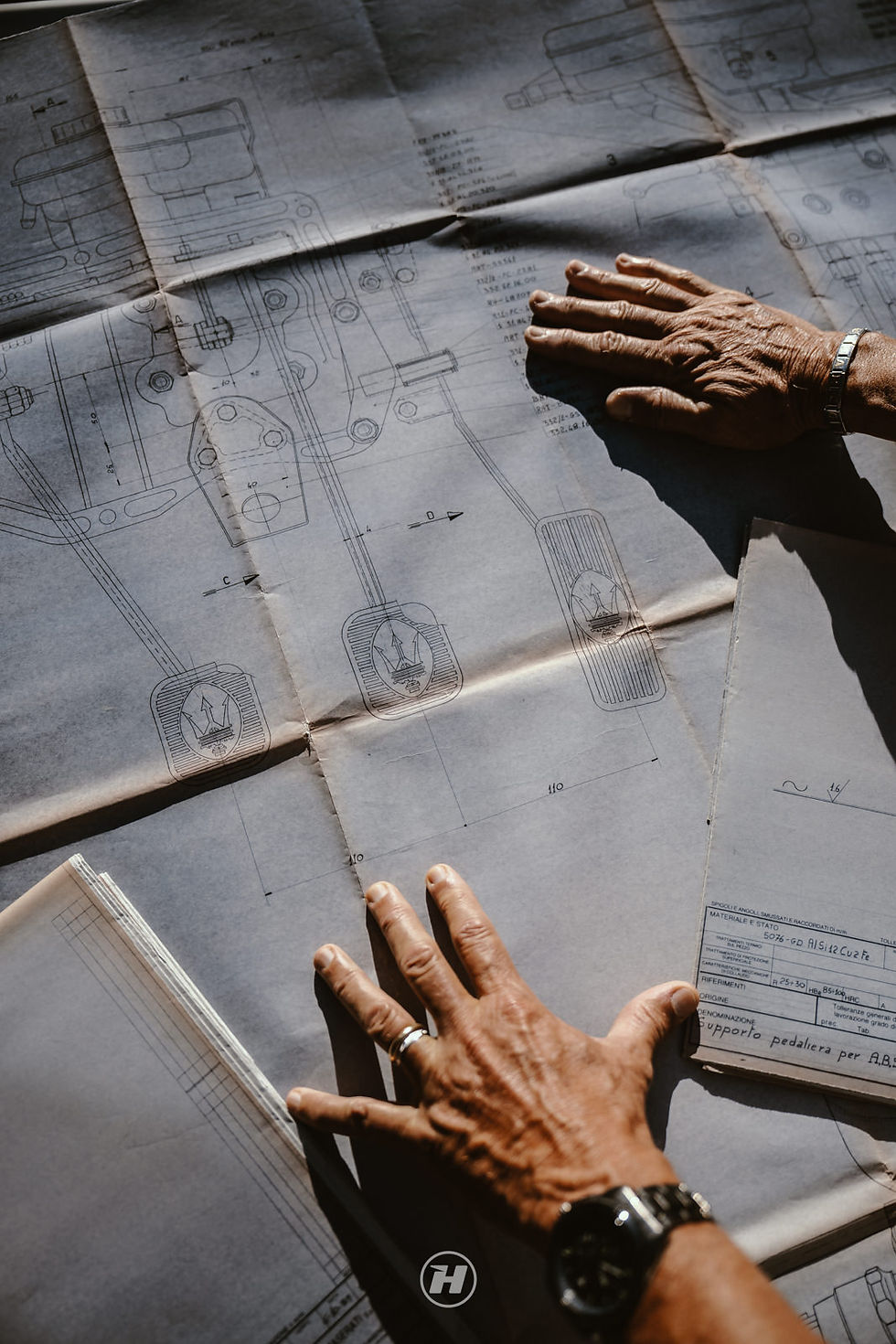
To Marco Bergamini, born 1966, industrial technician and mechanical designer, fate assigned the “other side”. In 1988, at age 22, he entered the historic headquarters on Via Ciro Menotti and began working in meccanica fredda. In workshop jargon, that meant everything that wasn’t bodywork nor engine (the latter being, by nature, the hottest element of all). That meant transmission in all its components, brakes, steering and suspension. Marco worked eight hours a day at the drafting board, one heliocopy after another: CAD-CAM was just around the corner, but had not yet completed its transition.
More concentration in the morning, less in the afternoon. After admiring those small groups of newly completed cars, he imagined—on a very distant day—being able to hold one of their steering wheels in his hands. But not the wheel of just any Biturbo—which at the time was the core business of the line-up—and not even that of the sumptuous Quattroporte (the President of the Republic’s car: how could a young man allow himself to desire such a transatlantic ferry?). The car that unsettled his afternoons was something in between: the 228. The most unusual member of the prolific Biturbo family, which at the time included coupés, Spyders, and the 420 and 425 saloons.

Alejandro De Tomaso, who had been Maserati’s father-master since 1976, not content with competing against Alfa Romeo and BMW (something never seen before the arrival of the Biturbo itself), decided he also wanted to present himself as an alternative to Mercedes-Benz in the upper-middle-class coupé segment. An even more ambitious undertaking, given that the image of a Maserati and that of a German car were as far apart as devil and holy water. But the considerable success enjoyed by the Biturbo and its companions (no fewer than 22 models in 16 years, a true record) convinced him to launch himself into this challenge as well. Working with him was not easy: he expressed his opinion about everything, tolerated no contradiction, refused to take decisions on Tuesdays or Fridays because they brought bad luck, and was said to walk around the factory armed and with a large dog of an apparently unfriendly temperament. Marco has no direct confirmation of the last two rumours (when personalities are so strong, it takes nothing for exaggerated, if not outright invented, anecdotes to spring up around them), but he does remember—and has seen in writing—the circulars, worthy of a totalitarian regime, that circulated through every department of the company. Here is what he wrote on 18 July 1991: “From: President. To: all relevant Departments. It is reiterated that any modification to the vehicles, even the most insignificant, cannot under any circumstances be carried out without prior authorisation from Mr A. De Tomaso. Anyone failing to comply with this directive will face severe disciplinary action.” In short, even if you changed a slotted screw for a Phillips to improve product quality or to solve a production impasse, you risked having a very bad time (or much worse, given the vagueness of the punishments threatened).

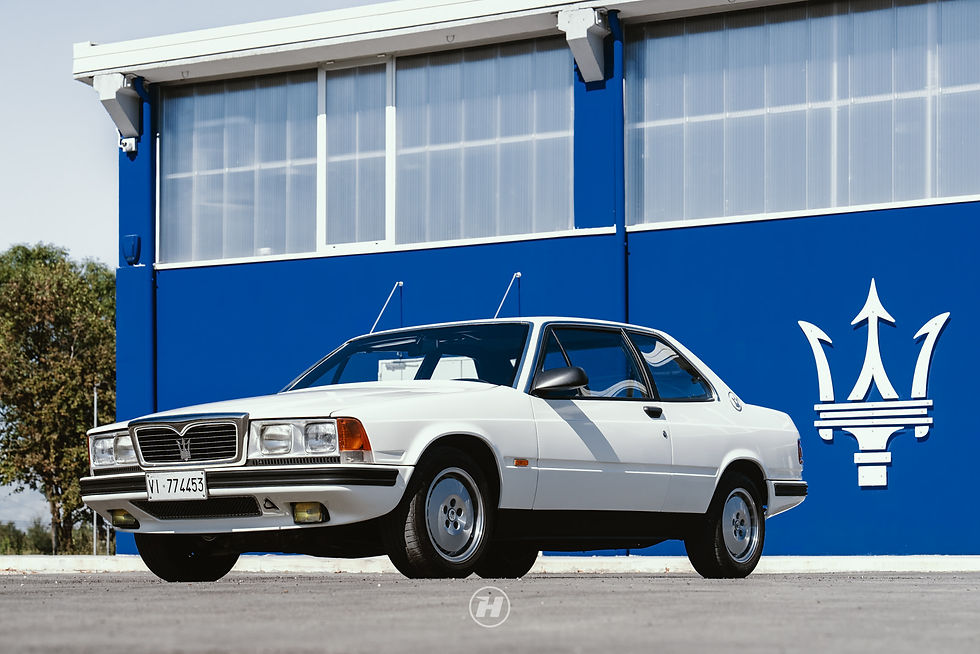
It was in this surreal climate that the 228 was conceived. Basically, the idea was simple and logical: take the longest wheelbase among the three planned for the Biturbo—the saloon’s 2.60 metres compared to 2.51 for the coupé and 2.40 for the Spyder—fit the largest engine in the twin-turbo V6 family, and cover everything with a specific body. And here things got complicated. Because, to give the new coupé a different aura—more bourgeois and less aggressive than the others—half the world had to be redesigned. Not a single panel matched those of the other models, which gives you an idea of how illusory any implicit notion of cost rationalisation really was.

Pierangelo Andreani, the same designer responsible for the first Biturbo, worked with a sure hand and managed to give the car a touch of nobility, not without indulging in a few flourishes: the raised rear edge of the bonnet, the one that “rests” against the windscreen, shaped to partially conceal the wipers; the thick border around the grille; the most elegant wheels ever fitted to a “small” Modenese car. To emphasise its difference, even the door handles were mounted above the upper side crease instead of below it, as on the others. The result is attractive, perhaps also thanks to its very imperfection: the body is 15 cm wider, but the tracks grow by only 38 mm at the front and 23 mm at the rear. The result: the wheels look lost inside the arches, sitting too far inward. A bit like those scale models where differently shaped bodies must settle for sharing a single chassis.
In those years Marco, dressed in his white coat (which Maserati designers were as proud of as the test drivers were of their very light blue suits), moved from one project to another. He drew the pedal assembly of a 4.18 modified to integrate ABS, and worked on the installation specifications of the Getrag five-speed gearbox that would end up, in 1990, in the Shamal, replacing the ZF units previously used. Every project was created in 1:1 scale—plan view, front view, rear view. In his first years at Maserati he often heard talk of that 228 that fascinated him so much. At Via Ciro Menotti they said that, yes, it was a provocation to Mercedes-Benz’s C124 series, but above all the car intended to continue the path opened by Maserati models of the past—sporty but less aggressive than the “small” Biturbo—such as the 3500 GT, the Mexico and the Kyalami. How could you not feel part of history, when you worked in a place where a car model was entrusted with a responsibility like that?
As successful as the early Biturbo had been, the welcome for its bourgeois relative would be lukewarm. If over 9,000 units of the original carburetted Biturbo were produced, only 469 examples of the 228 would leave the factory in four years. Almost all were exported, given that its displacement—close to three litres (hence the name 228, to be read as 2 doors, 2800)—made it undesirable in Italy, where heavy VAT of 38% instead of 19% applied to cars over two litres: indeed, that is precisely why the Biturbo had been born as a two-litre. Numbers so low as to make Marco’s dream of owning one even more unrealistic. But he told himself every day: when would I ever be able to afford a car like that?

And if they talked so much about the 228 at the factory, fuelling his curiosity as he returned from the canteen, it was because its genesis had been unusual. It was presented as a prototype on 14 December 1984, exactly three years after the Biturbo. De Tomaso always chose this date to launch new models because it was Maserati’s founding anniversary. And in 1984 the company celebrated nothing less than its seventieth year. At its first appearance the mechanics were very different from the final version: four valves, two spark plugs per cylinder, twin overhead camshafts per bank and carburettors. It remained on paper for a long time: production officially began only in spring 1986, on the eve of the definitive model’s presentation in Turin. The fuel and valve train systems had been completely rethought (and simplified): now it featured fuel injection, a single camshaft per bank, and three valves and one spark plug per cylinder. To favour export markets, deliveries in Italy began very late: at the end of August 1987. Because of the increased VAT, it was extremely expensive on the domestic market: its first list price was 72.8 million lire, more than double the base carburetted Biturbo’s 33 million. With just a little extra—79 million—a potential buyer could take home a Porsche 911 Carrera. Certainly, the very rich standard equipment partly justified the asking price: power steering, alloy wheels, height- and reach-adjustable steering wheel, central locking, automatic air conditioning, electrically adjustable front seatbacks, power windows, hand-stitched leather upholstery. Only four options: automatic gearbox, metallic paint, ABS and high-pressure headlight washers.
Rumour also spread that Maserati intended to expand the 228 range with a 428, a four-door version. Logical perhaps, but unfounded. The only (slight) variant of the model would be, from 1990, the catalytic version for the USA, with power reduced from 255 to 224 hp. It was produced for just one year, after which the 228 gave way to the 222 4v, which kept the 2.8 engine but increased it to 279 hp, mounted on the shorter, more angular body of the original Biturbo. The charm of the halfway point had faded too soon. And certainly the caudillo from Buenos Aires did not enjoy it—not even from the driver’s seat: for years, due to physical problems, he had handed the wheel to his trusted Ivano Cornia, a test driver who was asked to leave the proving grounds to chauffeur the boss around Modena. Very rarely in a Quattroporte, sometimes in a red 2.24, at other times in a black 4.24. Never in a 228.

By 1997 the De Tomaso era was already long over. And in that year, Marco Bergamini’s time at Maserati also came to an end, as he moved with different responsibilities to companies outside the sector. The years passed, but the nostalgia for those cars he had drawn parts for only grew. Especially for that 228 that disturbed every one of his returns to the office. “I just need to avoid one of the first fifteen built,” he repeated like a mantra. The first fifteen 228s, for the record, mounted the rear axle of the two-litre Biturbo but had stability problems. Then the day came in 2008 when he saw it. An immaculate example, in Swan White livery, with 86,000 kilometres since June 1989, when it was collected from the dealership by its first owner, a man from Vicenza who had passed away a few years earlier.
Apart from some scratches on the bodywork the car was sound, but it had one major mechanical problem: a cracked engine block. But Marco is someone who knows how to get his hands dirty and use spanners (and all the other tools). He dismantled it piece by piece in his home garage, with wooden posts supporting the body because he didn’t have a lift.

Every single bolt was zinc-coated; he even overhauled the rear axle, sandblasting it himself, and launched into an authentic treasure hunt for the missing pieces: he found the bearings in the United States, had the piston rings reconstructed, based on samples, by a specialist in Turin. He granted himself one single licence, though a modest one: two pairs of exhausts, which were regularly fitted to cars destined for export markets, whereas in Italy the 228 had only one pair, on the right. It took eight long years of evenings stolen after dinner to reach, in 2016, the final result. Today the 228 still stands proudly in his garage next to a more recent, less aristocratic but equally underrated product of Italian industry: a 1997 Lancia K saloon. By sheer coincidence, the very year he left Maserati. Even if, in truth, he never really left it at all.


About the author, Marco Visani. Born in Imola in 1967, he has been a journalist since 1986. After beginning his career as a reporter for Il Resto del Carlino and other local newspapers, he has been writing about automobiles since 1992.
He has worked with magazines such as Quattroruote, Ruoteclassiche, TopGear, Youngtimer, Auto Italiana, Auto, AM, Sprint, InterAutoNews, and EpocAuto; with TG2 television; the portal Veloce.it; and with the English publisher Redwood Publishing, active in the field of customer magazines. He is currently the Italian correspondent for the French classic-car magazine Gazoline, editor-in-chief of the bimonthly ZeroA, and contributor to L’automobileclassica, Youngclassic, Quadrifoglio, and Tutto Porsche. He also manages heritage communication for Volvo Car Italia. His writings have appeared in Corriere dello Sport-Stadio, Avvenire, Tecnologie Meccaniche, Rétroviseur (France), and Top Auto (Spain). He has published and co-authored several books for Giorgio Nada Editore other publishers from 2016 to 2021.


Comments