

Jaguar, Anatomy of a Crisis
- Marco Visani

- Dec 15, 2025
- 7 min read
Energy transition, rebranding, a repositioning aimed far higher upmarket than ever before. The Coventry marque is living through one of the most difficult seasons in its long, turbulent history (and that’s saying something), not least because it has now been almost a year since Jaguar last built a single car—waiting for the brand’s full-electric relaunch scheduled for 2026. With the market at a practical standstill and a revolving door of CEOs, what future awaits one of Europe’s most storied manufacturers?
Words Marco Visani
Classic photography Jeroen Vink for SpeedHolics Other photos Jaguar Land Rover Limited

It is a freezing winter Tuesday evening, 12 February 1957. At Browns Lane, home of Jaguar’s main factory, hundreds of freshly completed cars are lined up in storage. A fair number of Mk VIIM flagships, many 2.4 and 3.4 Litre saloons (the compact four-door later known as the Mk1), a handful of XK140 roadsters—and nine XKSS. The last workers have only just clocked off the afternoon shift when a devastating fire, breaking out from the tyre warehouse, engulfs the facility, destroying much of the finishing line and rendering more than a third of the factory unusable. A catastrophic blow contained only through the stubborn will of William Lyons—recently knighted—and the workforce. Workers salvage bolts, whatever sections of walls and sheet metal they can, and within just a few days production resumes, albeit at a crawl.Jaguar has indeed weathered more than a few storms in its century-plus existence.
It begins with the fact that the company was founded in 1922, yet the history books mark its birth as 1945—because only in the immediate postwar period did it adopt the name we know today. Previously the firm was the Swallow Sidecar Company, universally referred to as “SS”—a deeply uncomfortable acronym after the crimes of the Nazi Schutzstaffel.
Compelled by history itself to rebrand—an almost unique case in the automotive world—Jaguar entered the 1950s with head held high and, despite the 1957 fire, emerged with its image bolstered by international success, especially in the United States. Daimler and Coventry Climax entered the company’s shareholding. It was in this phase of expansion, in 1961, that the E-Type was born—probably the most iconic Jaguar ever built, celebrated as much by the jet set as by cartoonists.

But the calm was short-lived. In 1966 the marque was absorbed by the British Motor Corporation (which would become British Leyland two years later), a motley conglomerate of mass-market brands in which Jaguar was an undeniable misfit. And yet life went on, even this time, even after Sir Lyons stepped aside: new models arrived that would define eras (the XJ above all), and the V12 engine debuted.


The E-Type, forced to navigate the transition from boom years to far tougher times, passed the baton to the XJ-S. It was more a survival float than a confident swim forward—one that, under Thatcher’s government, led in 1980 to Jaguar being carved out of the holding company, staff cuts, and a stock-market listing. Its stay on the London Stock Exchange was brief—barely a decade. In 1990 Ford acquired Jaguar, and in 1998 placed it under the Premier Automotive Group, alongside Aston Martin, Land Rover, Volvo and—across the Atlantic—Lincoln. The result was another false start, producing one model in particular—the X-Type—that shared its platform and major components with the Ford Mondeo, and which introduced body styles and technical choices hardly coherent with Jaguar’s heritage: a station wagon, front-wheel drive, and a Diesel engine.


As the PAG dissolved, Jaguar once again changed hands—this time along with Land Rover, with which it effectively merged—passing to India’s Tata Motors: the former colony purchasing one of the jewels of the Crown. At first, things went rather well. The line-up was broad—saloons, estates, coupés, convertibles, SUVs—and the market responded. Then something went wrong. Very wrong.


In April of this year, Jaguar sold just 101 cars across all of Europe, compared with 1,951 in April 2024—a 94.8% drop. Looking at the first four months of the year, the contraction is slightly less dramatic but no less alarming: –76.6%.
What lies behind this collapse? The energy transition, which is tormenting the entire European industry as it braces for the prospect of zero-carbon rules from 2025, is only part of the story. It is normal—painful, but normal—that factories slow down and resort to furloughs during generational changeovers between model lines. But what is happening to Jaguar has no precedent.
In November 2024, Jaguar stopped all production lines (E-Pace, F-Pace, I-Pace, XF, XE and F-Type) pending a radical overhaul of the line-up, which is to relaunch in 2026 with three all-electric models. All current cars remain available only until stock runs out—and only outside the UK, a further oddity. A year-plus production freeze is an extraordinary move. Painful for workers, painful for the dealer network, painful for the brand’s image. And the explanation given by former CEO Adrian Mardell was astonishing: “Jaguar vehicles do not deliver economic returns.” As if to admit they had knowingly been building cars with no margin.


Yet even this unusual approach to transition pales when compared (and especially when paired) with the risky rebranding operation entrusted to an external agency—Nothing, a name that feels ominous in hindsight—unveiled on 19 November 2024.
The new logo and lettering are anything but engaging: a naïve alternation of upper and lowercase, the suppression of typographic ascenders and descenders, and an aesthetic faintly reminiscent of a certain high-tech vacuum-cleaner brand. The leaper—the famous Jaguar mid-pounce—has vanished. But above all, the communication is strikingly abstract.


It leans into a vaguely “woke” framework—at least in intention—built around five cryptic taglines: create exuberant, live vivid, delete ordinary, break moulds, copy nothing (the last supposedly quoting Sir Lyons).
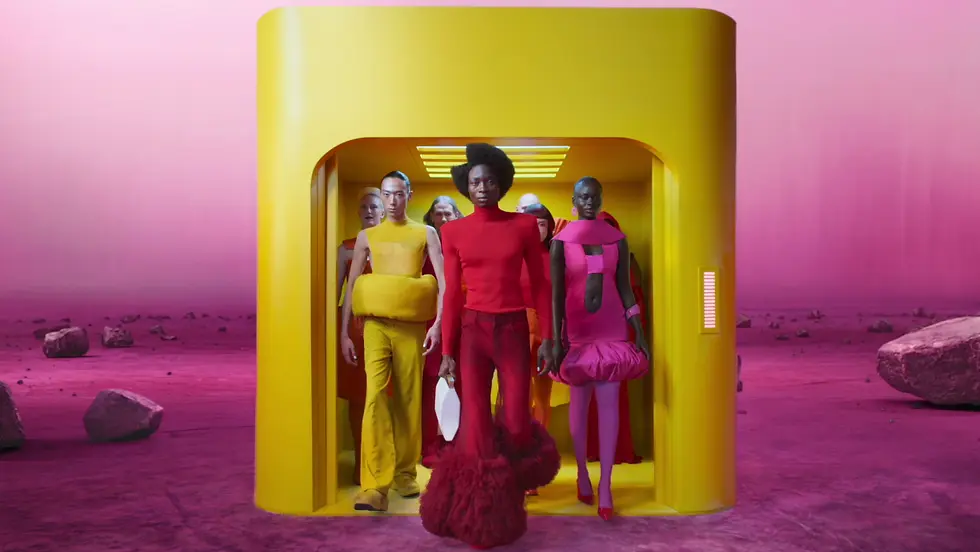
These accompany a 30-second fashion-film “reel” designed to announce Jaguar’s new course without showing a single car (not least because none exist). Instead, eight latex-clad figures move ambiguously through a lunar-dreamlike environment dominated by pink and baby-blue tones.

Those colours, as we learned two weeks later, were clues to the colourways—Miami pink and London blue—with which the Type 00 would be unveiled at Miami Art Week, a deliberately non-automotive setting. And when the concept finally appeared, many observers might have preferred the car-less video. The “zero zero” is a concept whose styling—despite a long bonnet that faintly nods to the legendary E-Type—has triggered debate, controversy, and even mockery throughout media and social networks.


Some saw the rear grille as resembling the outdoor unit of a home air conditioner; others, more mischievously, likened the profile to a comic-book Batmobile. Leaving styling aside—explosive in its own right, given its deliberate severing of all ties with the past—it is the declared intention to reposition Jaguar at the top tier of the luxury market that has raised eyebrows.


Throughout its existence Jaguar has always represented accessible luxury: distinctive, personal, never ostentatious, and priced well below Bentley and Rolls-Royce—against which it now apparently intends to compete, if the production version of the Type 00 becomes the four-door grand tourer promised. Even CEO Rawdon Glover acknowledged in a July 2024 interview with Quattroruote that “probably 10–15% of our current customer base will stay with us—so relatively few.”


Confident that it can rely on conquest customers, Jaguar has not, unlike other brands, reconsidered its timing for abandoning combustion engines—those other brands having already adjusted their schedules to match the weak demand and the not-so-subtle hope of regulatory backtracking. Quite the opposite.


In the same interview, Glover stated that “with any platform (in this case the JEA, Jaguar Electric Architecture), it’s always a long-term game. It takes six years to bring it to market and then you have a nine-year cycle. So when you make a platform decision, you are committing for 15 years—and it’s hard to walk that back.”

And yet walk back they have—at least at the shareholder level. On 1 August, Tata Motors accepted (or perhaps encouraged?) the resignation of CEO Adrian Mardell. And in December came news that Chief Designer Gerry McGovern, too, had been shown the door.
Automotive boardrooms have seen no shortage of departures lately—from Carlos Tavares (Stellantis) to Luca de Meo (Renault), from Wayne Griffiths (Seat–Cupra) to Jim Rowan (Volvo). But Mardell’s abrupt retirement—despite approaching 65 and having 35 years of service—cannot be unrelated to the radical transformation he oversaw, which is so far delivering anything but the expected results. Coventry’s spin does little to hide it: they insist that the wave of debate surrounding the Type 00 and the now-famous reel has produced unprecedented visibility (which is undeniably true).
But numbers speak too: according to the authoritative InterAutoNews, quoting ACEA statistics, Jaguar sold just seven cars (yes, seven, spelled out to avoid doubts) in Europe in July 2025, compared with 1,460 in the same month the year before—a 99.5% collapse. Which is to say that Jaguar is, for all practical purposes, extinct. Or at least completely motionless. At this point one must ask whether the timeline will hold (the GT derived from the Type 00 is due to debut late this year and reach showrooms—if any are left—by the first half of 2026) and whether there truly is a future for this cornerstone of European motoring culture.

A few days after Mardell’s departure, Jaguar Land Rover announced that on 1 November leadership will pass to Pathamadai Balachandran Balaji, until now Chief Financial Officer at Tata: a numbers man, suggesting a future oriented more toward balancing books—especially with Trump-era tariffs targeting the US market—than imagining new worlds and new audiences through ethereal visions. For now, we prefer to take comfort in history, which is why we chose to present images of two E-Types. Across fourteen years, roughly 70,000 E-Types were built between the OTS and FHC (Fixed Head Coupé). We like to think of it as a good omen for a brighter future—and that the current turmoil is just one more of Jaguar’s many crises. Hoping, once again, that it may rise from its ashes.

About the author, Marco Visani.
Born in Imola in 1967, he has been a journalist since 1986. After beginning his career as a reporter for Il Resto del Carlino and other local newspapers, he has been writing about automobiles since 1992.
He has worked with magazines such as Quattroruote, Ruoteclassiche, TopGear, Youngtimer, Auto Italiana, Auto, AM, Sprint, InterAutoNews, and EpocAuto; with TG2 television; the portal Veloce.it; and with the English publisher Redwood Publishing, active in the field of customer magazines. He is currently the Italian correspondent for the French classic-car magazine Gazoline, editor-in-chief of the bimonthly ZeroA, and contributor to L’automobileclassica, Youngclassic, Quadrifoglio, and Tutto Porsche. He also manages heritage communication for Volvo Car Italia. His writings have appeared in Corriere dello Sport-Stadio, Avvenire, Tecnologie Meccaniche, Rétroviseur (France), and Top Auto (Spain). He has published and co-authored several books for Giorgio Nada Editore other publishers from 2016.


Comments