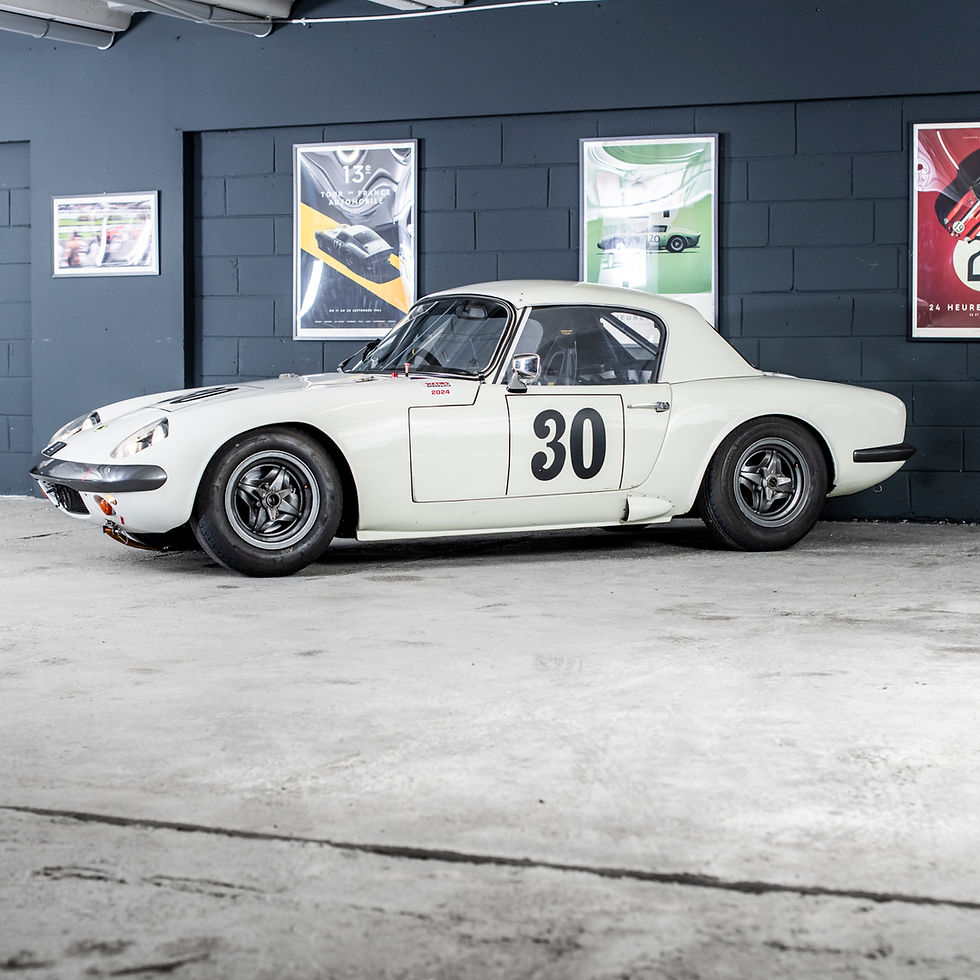
When Jaguar unveiled the E-Type at the Geneva Motor Show in March 1961, the impact was nothing short of seismic. A surprise, first and foremost, because no prior information had filtered out regarding Coventry’s forthcoming Grand Touring car. But also because the E-Type’s silhouette instantly captivated the public. Penned under the guidance of William Lyons, combining a sporting chassis with genuine comfort and first-rate performance, the new Jaguar E-Type redefined expectations. Not to mention its astonishing price positioning at the time: three times cheaper than a Ferrari and fully twice as affordable as a Maserati…
Since the end of the war, Jaguar had come to embody the very essence of British-style Grand Touring. The lineage of XK roadsters (from XK120 through XK150) played a major role in shaping this sporting image, reinforced by numerous victories in top-level competition. Yet, by the dawn of the 1960s, despite their undeniable qualities, the XK models could no longer conceal their age. Quietly and away from prying eyes, Coventry began work on their successor. Contemporary journalists were kept entirely in the dark, and the few perspective drawings released bore little resemblance to reality.
On March 15th, at the Geneva Motor Show, journalists swarmed the Parc des Eaux-Vives, eager for a first glimpse of Coventry’s new star. Once inside the show itself, the E-Type caused a sensation. Praise was unanimous and ecstatic. Each appearance of a Jaguar E-Type on the street drew immediate crowds. Numerous celebrities and public figures rushed to place their orders: Françoise Sagan, Johnny Hallyday, Bernard Consten, Charles Trenet, Pierre Bardinon, Robert Hirsch, not to mention royalty. And beyond its breathtaking lines, the Jaguar E-Type could also boast a chassis that was remarkably advanced for its era…
The design of the Jaguar E-Type is often attributed solely to Sir William Lyons. Yet, as with any automotive genesis, behind the figurehead stood a dedicated team working in the shadows. The actual author of the pencil stroke was Malcolm Sayer, an aerodynamicist from the aviation industry. Draped over a remarkably light tubular chassis, Sayer’s work endowed the E-Type with an immensely long, flat bonnet that quickly became central to its magnetic appeal. The clamshell bonnet opens fully forward, revealing the entire mechanical assembly. At the front, a small grille evokes a slightly parted mouth, suggestive and unmistakably sensual, flanked by twin round headlamps set beneath glass covers. The rear adopts a fastback profile, with the roofline flowing seamlessly into slender tail lamps. Glazing is framed by thin, elegant chrome-finished pillars, while the rear wings display pronounced, voluptuous curves. There is no denying the charm and femininity of this design. Interior finish is beyond reproach, and a generous luggage compartment made long-distance touring a very real proposition—precisely the vocation of a true GT.
Jaguar owes so much to the XK engine that its story cannot be told without revisiting its origins. When the Jaguar XK120 roadster debuted at Earls Court in 1948, public reaction was immediate and overwhelming. Its name derived directly from its engine and performance: powered by the XK inline-six, the XK120 was capable of 120 mph. Originally a 3.4-litre unit with a cast-iron block and aluminium cylinder head, featuring twin overhead camshafts, it was truly advanced for its time. For the E-Type, Coventry installed a bored-out version of the XK engine, now displacing 3.8 litres (87 x 106 mm) and retaining its long-stroke character. The result was increased torque available from low revs. Factory figures quoted 265 SAE horsepower at 5,500 rpm and 35.9 mkg of torque at the same engine speed. Even today, the performance delivered by the 3.8-litre XK remains impressive: a top speed of 240 km/h and 0–100 km/h in under eight seconds.
The chassis of the Jaguar E-Type received the utmost attention, with numerous solutions directly inspired by competition. For the new Coventry GT, chassis engineers Bob Knight and Norman Dewis devised a rear subframe independent of the monocoque, carrying the rear suspension, brakes and differential. This assembly was mounted to the body via V-shaped rubber mounts, isolating the cockpit from suspension-induced disturbances and road imperfections. At the front, the architecture was almost a direct carryover from the D-Type race car, featuring double wishbones, with the lower arm accommodating the forward end of the longitudinal torsion bar. To rein in its sharp-clawed feline, Jaguar adopted disc brakes on all four wheels, a technology proven at the 24 Hours of Le Mans in 1953 with the C-Type. A dual-circuit braking system was also fitted. With a kerb weight of just 1,220 kg, the E-Type enjoyed an excellent power-to-weight ratio, fully justifying its status as a genuine sports car. Road holding was notably modern, but it was the comfort that truly surprised—foreshadowing Jaguar’s enduring reputation for chassis excellence.
Unlike the D-Type, the E-Type was not initially conceived as a race car. Nevertheless, the factory supported several well-known privateers. Graham Hill, driving for Equipe Endeavour with chassis ECD400, and Roy Salvadori for John Coombs in BUY1, achieved notable successes in 1961 against the dominant Ferrari 250 GTs—despite competing with a road-based car against purpose-built racing machines. No Jaguar appeared at Le Mans in 1961. However, Coombs’ car was in fact a factory development vehicle, built with thinner-gauge steel monocoque panels. It reappeared at the start of the 1962 season as 4WPD, fitted with a wet-sump D-Type engine, improved brakes and suspension, and an aluminium hardtop. Destroyed during the Easter Monday Meeting at Goodwood, the car was rebuilt by the factory to what would become known as “Lightweight” specification.
Subsequently, eleven additional Lightweight E-Type roadsters were produced, along with two coupés and around ten semi-lightweight cars. True Lightweight specification included a fully aluminium monocoque, a dry-sump 3.8-litre all-alloy engine with wide-angle D-Type cylinder head, Lucas mechanical fuel injection, a ZF five-speed gearbox, Mk IX disc brakes, aluminium hardtop, doors and boot lid, widened rear track with modified Mk X wishbones, anti-dive front suspension geometry, lowered steering rack, competition seats, and special Dunlop alloy wheels akin to those of the D-Type. Weight was reduced by some 270 kg, and with over 340 horsepower, the E-Type became a genuine rival to the Ferrari 250 GTO. Reliability issues, however, led to many alloy engines and ZF gearboxes being replaced by cast-iron Jaguar units and in-house transmissions. Ultimately, the factory never fully committed to the programme, and by 1964 it was over. The Lightweight arrived two years too late and was never sufficiently developed.
Today, FIA-spec Jaguar E-Types compete successfully on circuits worldwide. Their sporting qualities make them formidable contenders, whether on the demanding special stages of the Tour Auto, the fiercely contested TT at Goodwood, or endurance races such as the Sixties’ Endurance and the Spa Six Hours.
Built in 1963, this Jaguar 3.8-litre OTS Semi-Lightweight benefits from an exceptional provenance and has been prepared to the highest standards for historic competition.
Originally prepared by C2C several years ago for one of its clients, the car successfully competed in several prestigious Peter Auto events before being acquired, through our brokerage, by a prominent French collector.
Under the current ownership, the Jaguar has continued its successful competition career, taking part in numerous Sixties Endurance races as well as several editions of the Le Mans Classic, proving both its competitiveness and outstanding reliability.
Fully compliant with its FIA Historic Technical Passport (HTP), this Semi-Lightweight features all the specifications sought after by the most demanding historic racers. Built on a steel monocoque fitted with lightweight aluminium panels, it is equipped with Dunlop MK9 brakes, ‘peg drive’ wheels, and benefits from a highly developed competition specification throughout.
Power comes from an all-aluminium engine featuring a ‘wide angle’ cylinder head and Weber 48 carburettors. The engine was expertly built by renowned Jaguar specialist Nick Finburgh using premium Crosthwaite & Gardiner components and produces approximately 370 horsepower, delivering exceptional performance while remaining faithful to the spirit and engineering of the period competition cars.
Ready to compete in the world's most prestigious historic racing events, the car is offered with French registration, a current FIA Historic Technical Passport (HTP), a complete spare set of wheels, and a complete cast-iron ‘straight port’ spare engine, providing both valuable race support and long-term preservation of its mechanical heritage.
With its outstanding provenance, first-class preparation and highly desirable specification, this Jaguar 3.8-litre OTS Semi-Lightweight represents a rare opportunity to acquire a front-running historic competition car, eligible for the most prestigious international historic racing events.