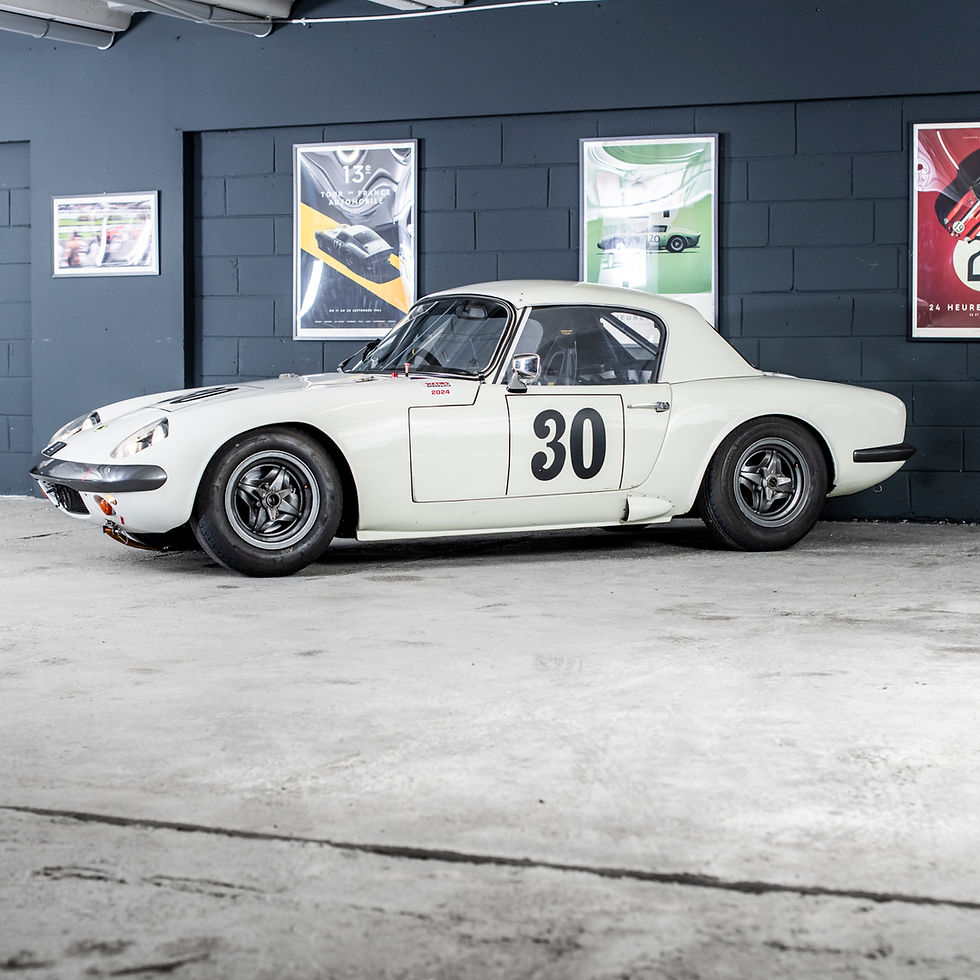
For Lotus, 1962 was arguably the most important year in the company's history. In a short space of time, they launched the revolutionary 25 Grand Prix, the first true monocoque, and the revolutionary 26 or 'Elan', an equally revolutionary road car. If the 25 won the British company its first Formula One championships, the Elan confirmed the small firm's seriousness as a sports car manufacturer. Lotus founder Colin Chapman could be forgiven for not building a competition version of the Elan. However, this did not stop his customers from taking their production cars to the track.
First modifications
Although the production car had fabulous handling and low weight, it had to be prepared for the track. Private teams such as Walker Racing and Chequered Flag took up the challenge and made various modifications to the steering and braking. Chapman followed the private efforts with great interest and even allowed his factory drivers to participate. The 1963 and 1964 seasons were very successful, and the cars were driven by the likes of Jim Clark, Jackie Stewart and Sir John Whitmore. As a businessman, Chapman quickly realised that there was a market for a factory-built racing version of the Lotus Elan.
Elan 26R
Chapman retained all the modifications made by his customers. In addition, the suspension was extensively modified with larger anti-roll bars and adjustable racing booms. The fibreglass body wheel arches were widened to make room for larger wheels and tyres. The Lotus four-cylinder DOHC engine was offered with a Cosworth or BRM tuning package. Interestingly, customers later discovered that the engine worked best with a Cosworth block and a BRM cylinder head. Dubbed the "Elan 26R", the competition car was offered with a Roadster body, roll bar and separate hardtop. Although no two cars were identical, most 26Rs were fitted with streamlined headlights and four-spoke wheels.
Success
The Elan 26R was fully homologated during the 1964 season. The race car weighed about 600 kg and its 1558 cc engine could produce between 160 and 175 hp depending on the settings. Its closest rival was the Alfa Romeo Giulia TZ, which was very light if a little heavier and also had a powerful 1.6 litre engine. Like David and Goliath, the racing Elan was also capable of matching cars with much larger displacement. While the Ferraris, Aston Martins and Jaguars outpaced the Elan in a straight line, the little Lotus was a match for it in the corners. The Elan was particularly effective on twisty or fast tracks like Goodwood.
Lotus never entered the 26R Elan under its own banner. Instead, it supported private teams, notably that of Ian Walker, who had been instrumental in developing the cars in the first place. Walker took his golden Elans all over the UK but also to the rest of Europe. Along with several other teams, the Elans have done nothing but dominate their class. The most successful 26R driver was future Lotus F1 driver John Miles. In 1966 he won the Autosport championship with
15 race victories in a Willment-prepared car. One of his most memorable victories came at Brands Hatch, against a V8-powered Sunbeam Tiger. As his bonnet came off, he was forced to make a pit stop. Once removed, he reeled in the entire field and passed the Sunbeam on the final lap.
Today
With many cars sold to customers as kits, it is difficult to give an exact figure for the number of Elan 26Rs produced. Most brand experts agree on a figure of 97 cars. Today, the 26R is still very popular with historic racers who sparkle at the wheel of the Elan. Many standard production Elans have since been converted to 26R specification.
Our Elan, built to FIA 26R specifications, has undergone extensive design and preparation work. A full spec, Series 1 Lotus Elan GTS (that's the FIA spec on the homologation forms) and is known as 26R spec in Lotus terms.
Basically it's fully road registered and legal and has:
26R spec chassis and suspension - very much like a standard chassis but with strengthening gussets and fully rose jointed suspension.
A super lightweight Series 1 26R body shell, roof and closing panels. The 26R has wheel arch flares. From Tony Thompson.
A 3/4 wooden dashboard as used in the series 1 26R.
Removable steering wheel.
26R spec AP brake calipers with modern race pads.
Knock-off, peg drive, 6J13 Magnesium wheels and magnesium final drive rear casing.
Close ratio gearbox (iron main case since the FIA banned magnesium ones).
Safety Devices cage.
Tillet race seat with lightweight harness.
Lightweight battery.
Craig Beck built engine at c. 175 BHP with twin 45 DCOE webers.
Heated windscreen; plastic side and rear screens.
Alloy radiator and header tank with electric fan.
Electrically triggered fire extinguisher.
Long distance, foam filled fuel tank.
Road legal lighting - headlights, turn indicators etc.
With an engine that has just been rebuilt in on a new cylinder head, it promises future buyers an extremely competitive and well-maintained car. It comes with a valid FIA HTP, an additional gearbox and rear Diff, and 8 wheels mounted. Among its many racing achievements, our Elan competed in numerous races with its previous owner in England, as well as at Dijon and Spa. With its new owner, it has been entered in the 10,000 Tours at Le Castellet and at Dijon for the “Age d’Or”.
Fully eligible for Peter Auto, Le Mans Classic, Le Tour Auto, and the Sixties, as well as for appearances on the set of *Motor Racing Legend*, this is a car built to shine at the front of the pack.