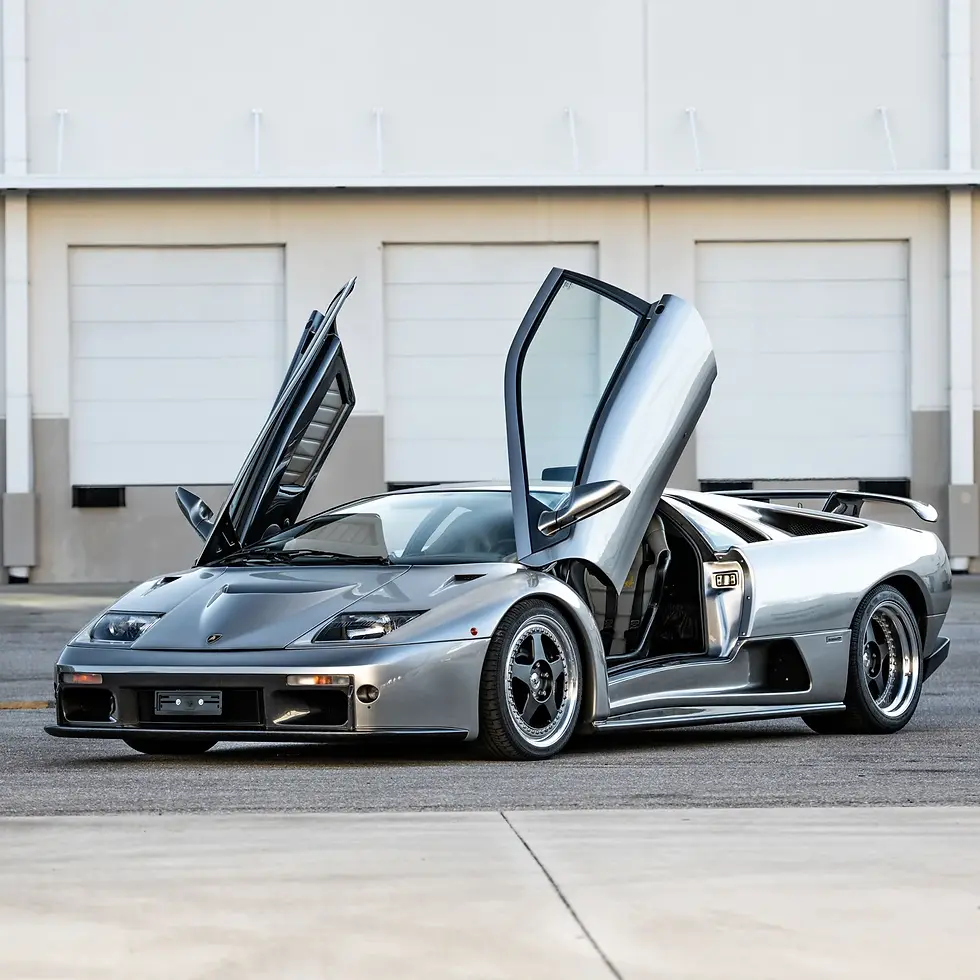
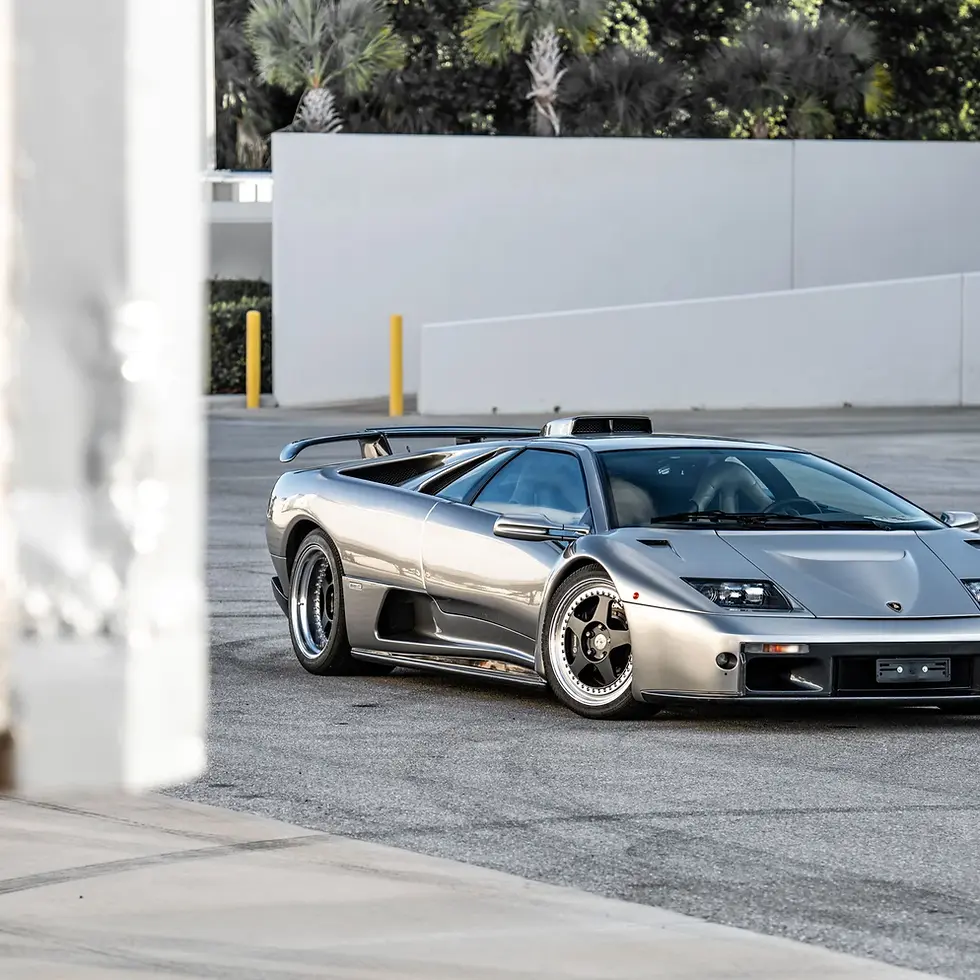
Chassis YLA12427 is number 39 of 80 Lamborghini Diablo GTs, finished in Argento Titanio over a bespoke Torpedo/Silver leather interior, and certified authentic by Lamborghini Polo Storico in December 2024 with its original engine, body, and chassis numbers intact.
Three points define the car:
• The model. The Diablo GT was the most extreme road-going Diablo ever built: a rear-drive, carbon-bodied, 575-horsepower homologation-inspired special, built in a single short run and never federalized for the United States.
• The rarity. Lamborghini offered the GT in four colors. Argento Titanio is widely reported in the collector market as a six-car color, making this one of the scarcest configurations in an 80-car model.
• The documentation. A Lamborghini Polo Storico Certificate of Authenticity is the highest third-party validation available for a modern Lamborghini. This car carries Certificate No. 23 of 2024, with grades of Excellent for bodywork and paint and Compliant across every mechanical and identification check.
The combination here is uncommon: a matching-numbers, two-owner, sub-20,000-kilometer car in the rarest of the four factory colors, with factory archive documentation and a current Polo Storico certificate. Very few of the 80 cars can present all five at once.
The build sheet records the interior in detail: full Torpedo leather with a silver leather center band on the seats and door panels, silver piping, and contrast stitching in gray on the Torpedo leather and black on the silver. The car was delivered with its tool bag, warranty card and chain, and owner's manual.
Why the Diablo GT Exists
The Diablo GT was the first Diablo commissioned by Audi after Volkswagen Group acquired Automobili Lamborghini in 1998, and it was not the car anyone expected.
The revised 1999 model year Diablo VT and SV had largely been developed under the prior Megatech ownership. With the Canto, the intended Diablo replacement, put on hold because the new management was unhappy with aspects of its design, Lamborghini's German owners instead ordered a heavily modified car that became the most extreme road-going Diablo yet.
The motivation was competition. Lamborghini's presence in GT racing through the 1990s had been intermittent, most recently a GT2-class Diablo run with the DAMS operation in a pair of French championship rounds during 1998. Results were promising, including a fifth at Spa, but the new ownership concluded a more radical base car was needed to contest the front of the field. The expensive new GT was conceived as that base, supporting a factory-sanctioned program with Reiter Engineering in the 2000 FIA GT Championship and spawning the 30-car GTR variant for the Supertrophy series.
In approach, the GT echoed the 1993 SE30: lighter, stiffer, rear-drive only, and more focused than the SV. But where the SE30 was an anniversary special, the GT was a technical leap. It was the first Diablo road car to abandon the 5.7-liter V12.
The prototype appeared at the Geneva Motor Show in March 1999. The production car was shown at Frankfurt that September, and customer deliveries began in October 1999. The GT was offered in left-hand drive only and, because of its reduced safety and emissions equipment, was never homologated for sale in North America.
Engineering and Specification:
Engine
The GT used a 6.0-liter version of Lamborghini's all-alloy, dry-sumped, 48-valve DOHC V12. Displacement rose from 5,709 cc to 5,992 cc by lengthening the stroke from 80 mm to 84 mm, with bore unchanged at 87 mm.
The extra displacement was the smaller part of the story. Lamborghini fitted an individual intake system with a single throttle body per cylinder, a magnesium intake manifold, new intake and exhaust camshafts, a new intake plenum, titanium connecting rods, a lightweight crankshaft, and gold cam covers. The LIE engine management was remapped for the variable valve timing, a large carbon-fiber airbox sat atop the engine with a digitally controlled airflow meter, and a twin-outlet exhaust used a bypass system to cut back pressure.
Compression went from 10.0:1 to 10.7:1. Output rose from 530 bhp at 7,100 rpm to 575 bhp at 7,300 rpm, with torque up to 465 lb-ft at 5,500 rpm. Drive went through a five-speed manual, a dry single-plate clutch, and a ZF final drive with limited-slip differential.
Chassis and running gear.
The GT was built on the rear-drive Diablo platform, deleting the all-wheel-drive hardware and the electronic Koni dampers. The square-tube steel spaceframe received additional reinforcement beyond the 1999 model year cars, which had themselves been stiffened 15 percent over earlier iterations.
Suspension geometry was revised and the track widened by 110 mm at the front and 30 mm at the rear. Single coil-over dampers were fitted at the front and two per side at the rear, with GT-specific anti-roll bars at both ends and anti-dive electronics on the front axle. Brembo cross-drilled and ventilated discs measured 355 mm front and 335 mm rear, with four-piston aluminum calipers all round, ABS, and a dynamic rear proportioning system. Eighteen-inch three-piece OZ wheels carried Pirelli P Zero tires, 245/35 front and 335/30 rear.
Bodywork
Apart from the steel roof and aluminum doors, every external panel was carbon fiber. The changes were extensive and almost entirely functional: a two-piece nose and bumper assembly with a carbon inlay, integrated chin spoiler, and enlarged oil cooler and brake intakes; a large vent in the front lid; flared front fenders with vertical cooling slots and reshaped NACA ducts; exposed carbon side skirts; a roof-mounted intake snorkel; and, at the rear, the bumper deleted in favor of a full diffuser with twin center-exit exhausts and a cockpit-adjustable exposed carbon spoiler.
Interior
Carbon-shelled single-piece bucket seats with four-point harnesses, exposed carbon on the transmission tunnel, dash fascia, center console, inner sills and door panels, a small three-spoke wheel with no airbag, a rearward-canted aluminum shift lever, and drilled aluminum pedals. Leather on the seat bolsters, Alcantara on the centers. Air conditioning, electric windows, and electric mirrors remained standard.
Production, Color, and Rarity
How many were built
Lamborghini planned a run of 80 customer cars. By the time production ended in mid-2000, 83 units had been completed. The market, the factory's own numbering, and Polo Storico all work from the 80-car series: cars are identified as n of 80, and this car's certificate states 39 of 80. A separate batch of 30 GTR race cars was built for the 2000 Supertrophy series and is counted separately.
For context on scale, roughly 2,900 Diablos of all types were produced between 1990 and 2001. The GT accounts for well under three percent of them.
Color
Lamborghini offered the Diablo GT in four colors: black, orange, silver, and yellow. Options were deliberately limited — airbags, comfort seats, full leather, two-tone upholstery, contrast stitching, and a spoiler-mounted camera tied to an Alpine console screen. Body-colored spoilers, GTR wheels, GTR exhaust, and GTR spoilers could be requested unofficially.
Silver, Argento Titanio, is the scarcest of the four. The figure circulating in the specialist trade is six cars, cited independently by dealers handling other silver GTs, including chassis YLA12460 (number 47 of 80). Lamborghini has never published an official color breakdown for the model, so this should be presented to a buyer as the accepted market figure rather than as a factory statistic. The Polo Storico certificate confirms the color itself: Titanium Silver at delivery and Titanium Silver today, unchanged.
The interior on this car goes further. Where most GTs left Sant'Agata in Nero, chassis 12427 was specified in Torpedo with silver leather inserts on the seat center bands and door panels, silver piping, and contrasting stitching. The registry describes it as a unique bespoke combination.
United States availability
The GT was never homologated for the United States. Period sources put the number that reached the country at four, imported privately. Every Diablo GT in the United States today, including this one, arrived through import rather than factory distribution, which is a meaningful part of why the model is thin on the ground here.
Polo Storico Certification
What the certificate is
Lamborghini Polo Storico is the factory's heritage department. Its Certificate of Authenticity is issued only after the department verifies title, confirms the authenticity of the chassis and VIN, establishes a known and uninterrupted history for the car, and physically inspects the vehicle's completeness and the function of the engine and main systems. The identification data must match the factory building sheet held exclusively by Automobili Lamborghini, and the fitted components must conform to original, period-correct parts.
The certificate lapses if the car is modified, if components are replaced with non-original parts, or if any identification element is tampered with. In practice, that makes a current certificate a statement about the car as it stands today, not just as it left the factory.
This car holds Certificate of Authenticity No. 23, 2024, a 44-page document signed December 18, 2024 at Sant'Agata Bolognese by Chairman and CEO Stephan Winkelmann and After Sales Director Alessandro Farmeschi. The verdict on the vehicle is unqualified: È AUTENTICA — IS AUTHENTIC.
Scarcity that compounds
Rarity in collector cars is only valuable when it is the kind buyers care about. Here it stacks in the right order: 80 cars in the series, four factory colors, a reported six in Argento Titanio, one bespoke Torpedo/Silver interior, and four cars that originally reached the United States. A buyer looking for a silver GT is not choosing among a dozen cars.
Documentation is the differentiator
The Diablo GT market has moved fast enough that the gap between a documented car and an undocumented one is widening. This car answers the three questions a serious buyer asks before anything else:
Is it matching numbers? Yes — engine 0049, body 4708, VIN punching all verified by the factory under Criterion (a).
Is the color original? Yes — Titanium Silver at delivery and today, per the certificate.
Is the history continuous? Yes — factory order, build sheet, period dealer correspondence, warranty card, warranty claim, and registry records with two owners from new.