The Lancia Delta S4 Corsa Group B
What is there to say about the Lancia Delta S4 which hasn’t been said before? In its full-fat Martini-liveried Group B guise, it took fearless and charismatic drivers such as Henri Toivonen and Markku Alén to another dimension of performance. And as a road car, it pioneered twin-charging, an innovation we take for granted nowadays, and proudly showed that road-going Group B homologation specials were not the poorly-built bodge-jobs they’d earned a reputation as being.
It’s wise to outline the popularity of rallying in the 1980s. A kaleidoscopic explosion of speed, noise and very real, very imminent danger, Group B deservedly drew a greater number of viewers than Formula 1. That’s why, despite the inherent risks, automotive brands could warrant funnelling enormous amounts of money into their WRC programmes, which were oriented around their otherwise modest cars you could find in the showrooms.
It’s also why, from a commercial point of view, Lancia (which, let’s not forget, was representing Italy on the world stage) simply had to up its game in 1985 if it wanted to win another title. The dominant success of 1983 was but a distant memory and Audi and Peugeot had proven that powering all four wheels was a quicker means of sending a rally car down a special stage than just two, a la 037 Rally. Decisive action was needed. In a bid to revive its incredible sporting heritage, Lancia greenlit the blank-sheet development of the 037’s new four-wheel-drive Group B successor, based loosely on the flagship Delta HF Turbo.
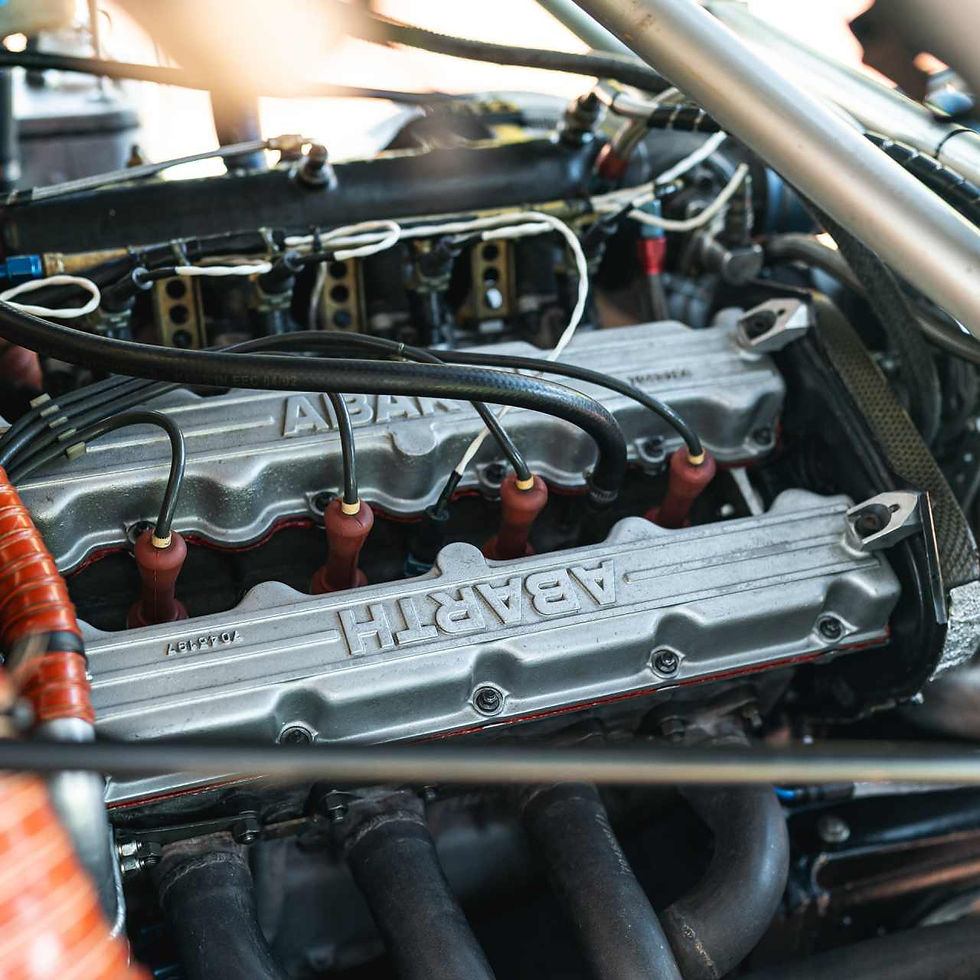
Christened the Delta S4, it trod a technological path very different to its rivals. The development was entrusted entirely to Abarth, whose creative, bullish and trailblazing engineers poured their everything into the project. Suffice to say, there was not a plan B.
In the mid-1980s, newfangled technology such as four-wheel drive and electronic ignition was in its infancy and Lancia’s competitors had stolen a march. They say imitation is the sincerest form of flattery. But without the knowledge to even copy its competitors, Abarth was forced to innovate. And innovate it most certainly did.
The Lancia Delta S4 Stradale was the first car to be ‘twin-charged’, that is fitted with both a supercharger and a turbocharger to better distribute the engine’s torque and reduce lag. It boasted an incredibly clever electronic injection and ignition – genuine Formula 1 technology at the time. The car’s spaceframe chassis was designed by computer. And the four-wheel-drive system was operated by three differentials. The result was a car which pushed the technological envelope to its boundaries and, frankly, made the ‘latest and greatest’ supercars from the likes of Ferrari and Lamborghini look antiquated.
Following a 34-month development period and what can only be described as some wishful counting on the part of the FIA officials, the Delta S4 was homologated on 1 November 1985 with the code DGM51831OM. Said code was displayed on the chassis plate in the door sills of the Stradale.
A few short weeks later, Lancia Martini Racing’s drivers Henri Toivonen and Markku Alén vanquished the opposition to score a one-two victory in the Lombard RAC Rally of Great Britain, the S4’s competitive debut. To put the rally car’s astonishing performance into context, an S4 turned a lap of Brands Hatch during a special stage which would have put it halfway up that year’s Formula 1 grid. It was an extremely encouraging result for the marque, which looked to be in good stead ahead of its 1986 WRC campaign.
As the 1986 season campaign panned out and Lancia’s new weapon emerged superior, so tragedy struck on the mountainous French isle of Corsica when Henri Toivonen and his co-driver Sergio Cresta perished after leaving the road in their Delta S4. “This rally is insane,” the Finn was reported to have complained just hours before the accident. “If there is trouble, for sure, I am completely finished.” It was a tragic precursor to a devastating loss.
Perhaps inevitably given the ferocious speeds and hopeless crowd control, Group B was canned by the FIA shortly after the Tour de Corse. Audi and Ford withdrew immediately, while Peugeot and Lancia continued in what was a season marred by tragedy. Notably, a Delta S4 won the season-closing Olympus Rally in the United States – the very last international round of Group B rallying.
Chassis no. 208
The factory Lancia Martini Racing Team first employed chassis number 208 for winter tyre testing, including here pictured in Lapland
Built by Abarth in October of 1985 to full-fat Evoluzione specification, this Delta S4 Corsa is chassis number 208. Its services were promptly employed by the Works Lancia Martini Racing Team. Resplendent in the legendary Martini livery, the car was transported to St. Remy high in the Aosta Valley, where the double World Rally Champion Miki Biasion used it to test Pirelli’s range of snow tyres ahead of the following year’s Monte-Carlo Rally.
Biasion wasn’t the only World Rally Champion to park his backside in chassis number 208’s narrow Kevlar bucket seat. Markku Alén also piloted the car during a further winter tyre test, this time in his native Finland. The thick knee-high snow flurries of Lapland were this time chosen to replicate Rally Sweden. For both tests, Abarth’s chief test-driver Giorgio Pianta co-drove, gathering invaluable first-hand knowledge about the different tyre compounds. In Monte-Carlo and Sweden, tyre choice plays a particularly pivotal role, so the importance of the educational work undertaken by this Delta S4 cannot be underestimated.
This Delta S4’s dominated its first competitive outing, the 1986 Rally 1000 Miglia, winning for the semi-Works Jolly Club team
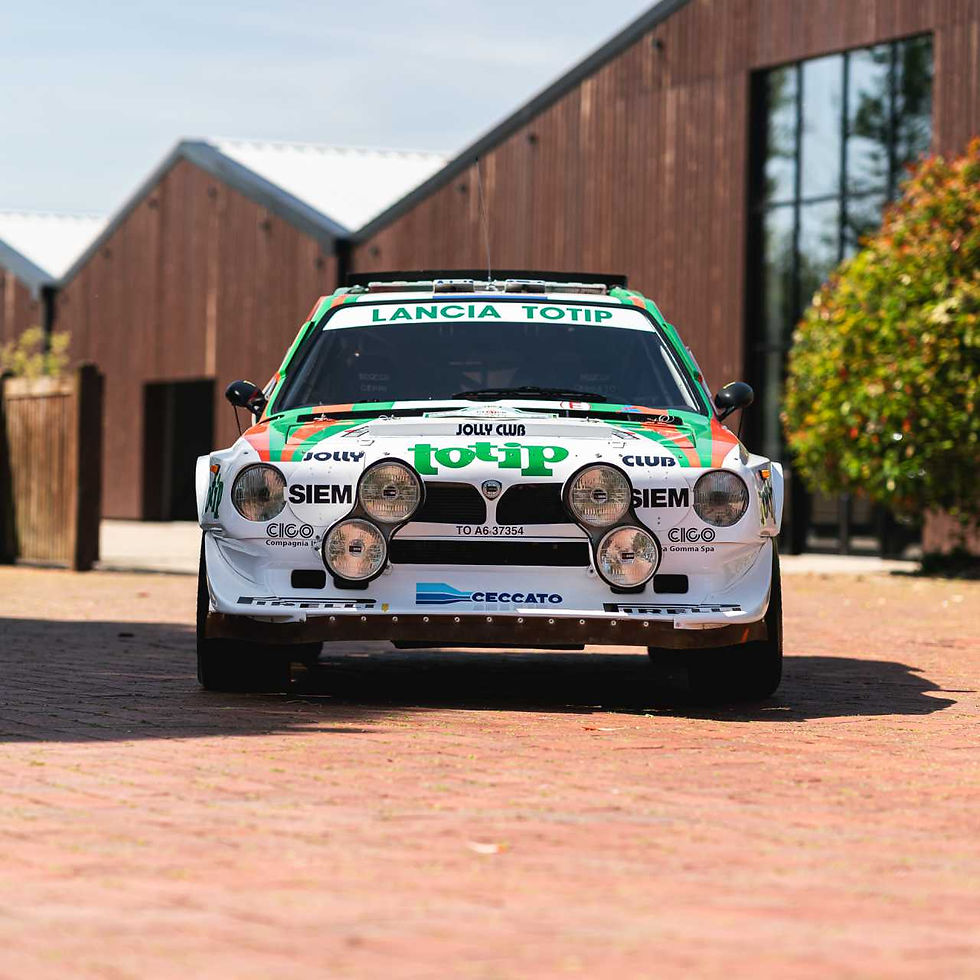
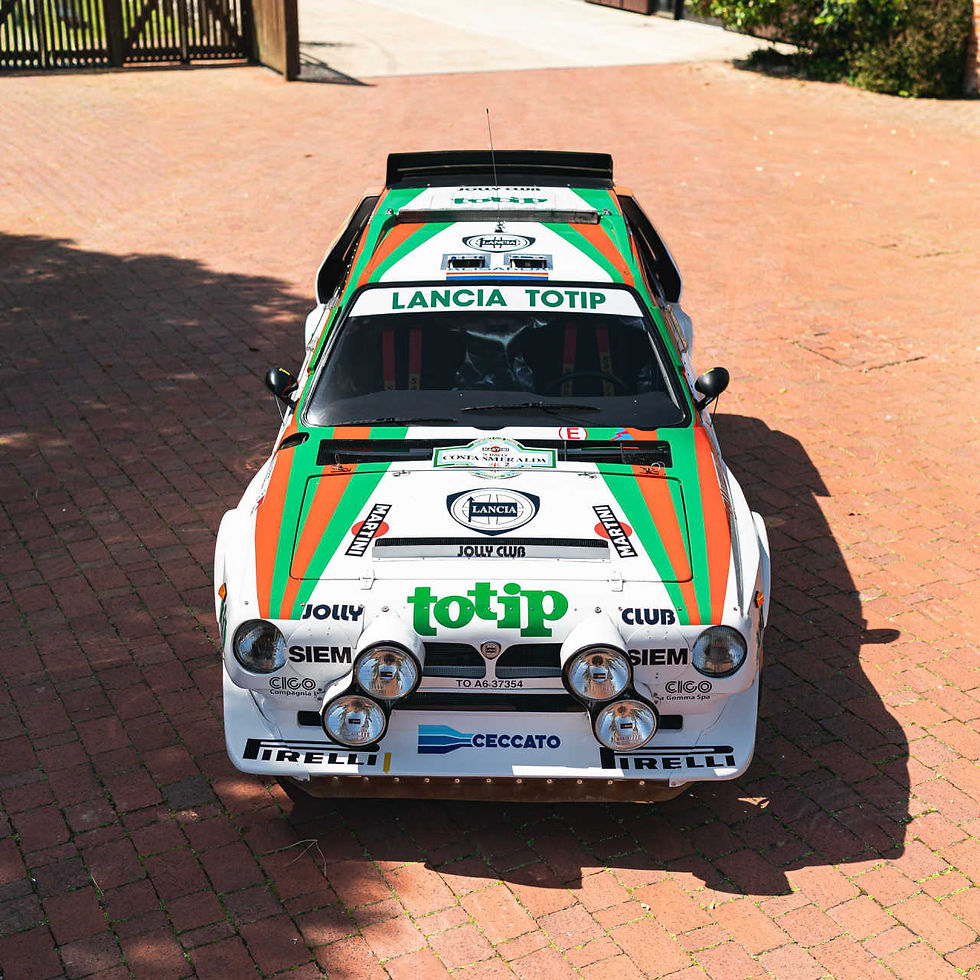
Its factory testing duties complete, this Lancia was assigned to the quasi-Works Jolly Club outfit and refinished in its striking white, green and orange ToTip livery. Chassis number 208’s maiden competitive outing finally came in March of 1986 in the popular Rally 1000 Miglia. Assigned the race number one, the car was piloted by the then-reigning European Rally Champion Dario Cerrato alongside his co-driver Giuseppe Cerri. The duo dominated the rally and won comfortably ahead of the sister Lancia.
Less than a month later this Delta S4 was back in action in Rally Costa Smeralda. A round of the European Rally Championship and, as a result, a significantly more prestigious event than Rally 1000 Miglia, Costa Smeralda attracted the might of the factory teams ordinarily competing on the world stage. Cerrato assumed driving duties once again and drove an exceptional rally. After securing three special stage victories, he and Cerri finished third overall behind the Works Lancia Delta S4 of Henri Toivonen and Works Peugeot 205 T16 of Andrea Zanussi. They also beat Fabrizio Tabaton, that year’s European Rally Champion.
Arguably chassis number 208’s most impressive result was finishing third overall in the Costa Smeralda, a round on the European Rally Championship
Just a few days after its podium in Sardinia, Fiat Auto S.p.A. registered this Delta S4 (as it did with all Lancia’s competition cars) in Italy with the Turin number ‘TO 77892E’. It subsequently made a starring appearance on Lancia’s stand at the Turin Motor Show. For the remainder of the 1986, chassis number 208 served as a test car for Jolly Club at events across the Italian, European and World Rally Championships. It’s worth noting that Dario Cerrato won the Italian Rally Championship – a campaign that got off to a stellar start with this very car.
This Lancia was sold to the first of its handful of Italian owners in 1988, who cherished the car over the course of almost three decades. Following an engine rebuild undertaken by respected Lancia specialists including Elio and Giovanni Baldi, chassis number 208 was acquired by the late John Campion. Not only did John maintain this Delta S4 regardless of cost and have it certified by Abarth Classiche. He also reinstated the ToTip livery in which the Lancia won and subsequently applied an easily removable whole-body wrap with the Martini Racing factory test livery. This car inspired him to start collecting further Martini-liveried Lancias, which he did. During his tenure as chassis number 208’s, John exhibited the car at the prestigious Amelia Island Concours d’Elegance, where it won a class award, and featured it in a stunning Petrolicious video aptly titled ‘A ballet of brutality’ (click here to watch it).
Tragically John passed away in 2020 at the age of 57. Max said this at the time. “We were honoured to be able to find great new homes for his beloved collection of Martini Racing Lancias, including this Delta S4. They were cars he cherished with boundless enthusiasm. John’s optimism and ambition were infectious and, by all accounts, attributes with which he forged his success. Having arrived in America from his native Ireland in 1984 with just 26 dollars in his pocket, John worked tirelessly as a roadie for the likes of AC/DC and Michael Jackson before using his entrepreneurial spirit and desire to innovate to conquer the world of energy provision.
“Despite having curated one of the world’s finest collections of historically significant competition cars, not once did John rest on his laurels. In recent years, for example, he devoted so much time and energy into celebrating the lesser-known motorsport heritage of his native Ireland, putting several initiatives for young Irish male and female drivers in place through his CJJ Motorsports organisation. As such, John’s legacy will be felt for many years to come.”
As Max touched upon, we found chassis number 208 a fantastic new home in 2020 with a well-known British collector of Group B road and rally cars. After reinstating the Jolly Club ToTip livery (this time with 1986 Costa Smeralda roundels and rally plaques) and road-registering the car in the United Kingdom, said owner has exhibited chassis number 208 all over. Prestigious historic motorsport events on this Lancia’s modern-era résumé include both Goodwood Speedweek and the Festival of Speed, RallyLegend and Rally Day.
The Delta S4 was – and remains – the ultimate Group B weapon. It’s an embodiment of all that was once great about the daring and innovative Lancia marque. It was the most technologically advanced rally car of all time, born into an era when resources were near-limitless and the performance envelope was pushed so far it had to be curtailed. The sport will, for better or for worse, never be the same again.
Chassis number 208 is a brilliant example of the breed. Not only did it serve as a crucial factory Lancia Martini Racing development car ahead of two of the toughest international rallies on the calendar, but it also enjoyed a stellar career in the European and Italian Rally Championships.